LHS grad helps secure the border
Publisher’s note: This story originally appeared in the Tuesday, Aug. 10, 2011, edition of the Lassen County Times.
For the son of a Janesville couple, helping secure our nation’s borders against potential threats meant enduring 12-hour work days, in desert like conditions where dust, sandstorms, and extreme heat were common.
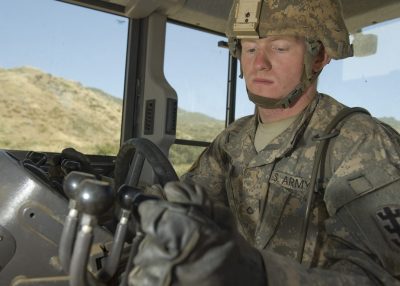 Army Pfc. Kurtis L. Hibbitts, a member of the 82nd Engineer Support Company, 65th Engineer Battalion, 130th Engineer Brigade, Schofield Barracks, Hawaii, was recently a part of an engineer support mission sponsored by Joint Task Force North, headquartered at Fort Bliss, in El Paso, Texas.
Army Pfc. Kurtis L. Hibbitts, son of Gerry S. and Beverly R. Hibbitts, was recently part of an engineer support mission, where he helped repair and upgrade more than three miles of all-weather border road along the U.S. and Mexico border, San Diego, California, sector, near the Tecate Port of Entry.
Hibbitts, a heavy construction equipment operator, is assigned to the 82nd Engineer Support Company, 65th Engineer Battalion, 130th Engineer Brigade, Schofield Barracks, Hawaii.
“I have been helping construct and improve roads along the U.S. and Mexican border,” said Hibbitts, who graduated in 2007 from Lassen High School, Susanville.
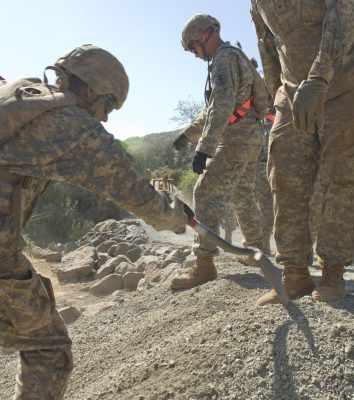 Soldiers spread gravel alongside a road allowing border patrol agents easier access along the San Diego and Mexico Tecate Port of Entry.
These support missions are coordinated by Joint Task Force North, a Department of Defense organization headquartered at Fort Bliss, in El Paso, Texas, and are routinely performed by active duty and reserve component units and individual military assets from all four military branches of service. The missions consist of road construction and improvement, border perimeter lighting installation, border fence construction, vehicle barrier construction, and mobility construction. These are long-term operations, planned one to two years before they begin and can consist of multiple phase operations that may take several months or years to complete.
These types of missions are twofold for Hibbitts. They provide an opportunity to gain valuable and unique training experiences in “real-world” military construction, mission planning, deployment, execution, and redeployment. They also help secure our nation’s borders, by helping the mobility and safety of the Border Patrol’s agents who are on patrol 24 hours a day, responding to suspected illegal activities along the border.
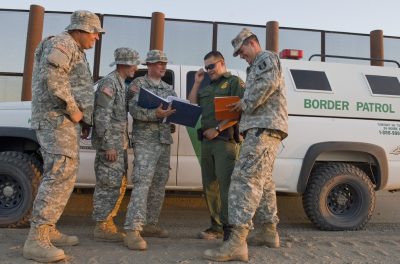 Soldiers speak with a border patrol agent about the progression of the all weather roads being constructed along the U.S. and Mexican border east of San Luis Port of Entry, south of Yuma, Ariz.
“This mission will help the border patrol by making the roads more accessible to places they need to be faster and safer,” said Hibbitts.
Besides providing Hibbitts with training opportunities, the missions also teach units how to work in a joint military and civilian environment, environments that they will encounter on deployments to Iraq and Afghanistan.
“I hope that this training will make me a better heavy equipment operator and help protect my country,” said Hibbitts, who has been in the military for more than one year.
As our nation continues to support the Global War on Terror in the continental United States, Hibbitts and the others can feel proud that they were able to be an integral part in helping to secure our nation’s borders to keep our country safe.