California has 48,028 pending family green card cases amid U.S. Citizenship and Immigration Services shift
A new study on behalf of Manifest Law has identified the U.S. locations with the most pending family green card applications.
For many immigrants with close relatives who are U.S. citizens or lawful permanent residents, family-based immigration is one of the main pathways to building a permanent life in the United States.
A foreign family member receiving a family-based green card can provide long-term stability, work authorization, greater mobility and a clearer path toward full participation in civic and economic life.
Those individual outcomes can also shape the communities where immigrants live: when families are able to remain together and gain permanent legal status, they may be better positioned to work, start businesses, buy homes, pursue education and contribute to local tax bases.
In recent years, the path to permanent residence has become more expensive and administratively complex for many families.
U.S. Citizenship and Immigration Services’ 2024 fee rule, which took effect April 1, 2024, increased the cost of several immigration filings and changed how some related applications are paid for, including work and travel authorization requests connected to adjustment of status.
These pressures are now unfolding alongside new policy signals that may further change how and where family-based green cards are processed.
This analysis — conducted by Manifest Law, a modern immigration firm specializing in employment, family and extraordinary ability immigration — examines USCIS family-based I-485 and I-130 approval data to identify the cities and states most impacted by the policy shift towards consular green card processing.
The findings show which field office areas have stood out, how approvals have varied by location, and what those patterns suggest about the local communities where family-based immigration is most visible.
 California has 48,028 pending family green card cases amid U.S. Citizenship and Immigration Services shift
Trends in family green card processing
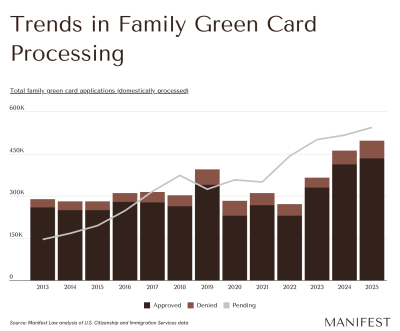
Field offices hit record family green card approvals in 2025, yet backlogs also reached new highs
USCIS approved 433,071 family-based green card applications in fiscal year 2025, the highest annual total on record and up 73 percent from 2015 levels.
Similarly, application denials also increased, reaching 62,389 in fiscal year 2025, an increase of 101 percent during the same 10-year span.
The rise in both approvals and denials suggests that USCIS has been moving more family-based adjustment cases to final decisions overall, rather than simply approving more cases. That pattern is consistent with the agency’s recent emphasis on increasing case completions by implementing process improvements to reduce barriers and speed up adjudications.
Despite record levels of family green card case completions, USCIS’s pending caseload also reached a new high. By the end of fiscal year 2025, the agency had 543,486 pending family-based green card applications, up 180 percent from 2015 and the highest total on record.
That growth reflects the other side of the adjudication system: approvals and denials measure cases completed, while pending applications represent cases still waiting for a decision.
A rising pending caseload alongside record approvals suggests that demand for family-based adjustment of status continues to exceed the system’s capacity to fully absorb it. Some of that pressure is structural, since family-sponsored preference visas are subject to certain annual limits and some cases cannot move forward until a visa becomes available, but a major shift to nearly entirely consular processing may further exacerbate the pending caseload backlog.
 Source: Manifest Law analysis of U.S. Citizenship and Immigration Services data | Image Credit: Manifest Law
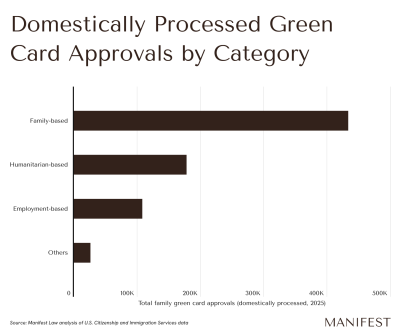
Domestically processed Green Card approvals by category
Accounting for over half of all domestically processed cases, family sponsorships far outpace employment and humanitarian green card pathways
Family sponsorship dominated domestically processed green card approvals in fiscal year 2025, reflecting the central role family reunification plays in the U.S. immigration system.
Of the 744,933 green card approvals processed inside the United States, 433,071, or 58 percent, were family-based. Humanitarian pathways accounted for 177,848 approvals, employment-based pathways accounted for 107,945 and all other categories accounted for 26,069.
In practical terms, that means USCIS approved roughly four family-based green cards for every one employment-based green card processed domestically. The gap reflects how the immigration system is currently structured: immediate relatives of U.S. citizens are not subject to annual visa caps, while family-sponsored preference categories are generally capped at 226,000 visas per year, compared with 140,000 for employment-based preference categories.
 Source: Manifest Law analysis of U.S. Citizenship and Immigration Services data | Image Credit: Manifest Law
Locations with the most family green cards pending
Florida has the most family green card applicants impacted by the shift to consular processing, with over 55,000 cases pending
Despite the institutional precedence to process more family-based applications than other categories, there remains a growing backlog of pending applications, leaving many families uncertain about the legal status of their loved ones in the United States.
Pending family-based green card applications were concentrated most heavily in the country’s largest immigrant-destination states. Florida field offices had 55,512 family-based green card applications in fiscal year 2025, the most of any state and over 7,000 more than California, which ranked second with 48,028 pending cases.
Texas followed closely with 39,183 cases, while New York ranked fourth with 35,919. Together, those four states accounted for 178,642 pending cases, nearly half of all family-based green card pending applications processed through field offices.
The pattern reflects where many immigrant families already live. Census Bureau data show that California, Texas, Florida and New York are among the states with the largest foreign-born populations, giving them larger pools of residents who may be eligible to sponsor relatives through family-based pathways.
At the field office level, the largest pool of pending cases were concentrated in major metropolitan hubs, led by the Dallas field office with 12,685 cases pending, Houston (12,607), Chicago (12,580), and Newark (11,837).
Rather than depending on one dominant office, Florida’s statewide backlog was different. Approvals in the Sunshine State were spread across several high-volume field office areas, including Orlando, Tampa, Oakland Park, West Palm Beach and Miami.
Pending family-based field office totals are best understood as a measure of where domestic adjustment cases are handled, not as a complete count of all family-based immigration tied to a state or metro area.
Adjustment of status applies to applicants who are already in the United States, while relatives applying from abroad generally complete the process through consular processing at a U.S. embassy or consulate.
Moving forward, USCIS’s policy change will likely push the vast majority of pending cases abroad, leaving the cities and states with the largest backlogs most impacted.
Here is a summary of the data for California:
• Total pending family green card applications: 48,028.
• Total pending family sponsorship petitions: 31,615.
• Share of green card approvals that are family-based: 48.2 percent.
• Total family green card approvals: 83,298.
• Total family green card denials: 5,766
For reference, here are the statistics for the entire United States:
• Total pending family green card applications: 543,486.
• Total pending family sponsorship petitions: 2,357,348.
• Share of green card approvals that are family-based: 58.1 percent.
• Total family green card approvals: 433,071.
• Total family green card denials: 62,389
Methodology
In order to determine the U.S. locations most impacted by the new USCIS family green card policy shift, researchers at Manifest Law analyzed the latest data from U.S. Citizenship and Immigration Services’ Immigration and Citizenship Data. Researchers ranked locations by the total pending Form I-485 family-based applications in fiscal year 2025 — commonly referred to as “family green cards.”
In the event of a tie, locations with greater total pending family sponsorship petitions — Form I-130 applications, which are petitions for alien relatives to establish the family relationship and are a precursor for the beneficiary to proceed with visa processing — were ranked higher. For additional context, researchers also included the total family green card approvals and denials, as well as the share of green card approvals that are family-based.
About Manifest Law
Manifest Law is a modern immigration law firm specializing in employment-based visas and global talent mobility. Its data-driven research offers clear insight into emerging immigration and labor trends. Additional commentary and insights can be provided on request.