Doolittle visits Lassen County
Publisher’s note: These stories originally appeared in the Tuesday, Aug. 15, 2006, edition of the Lassen County Times.
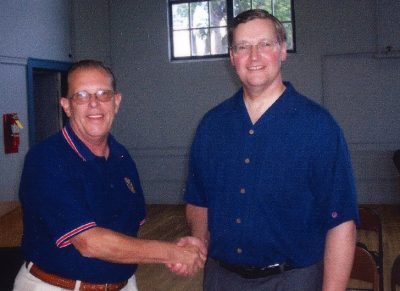 Fourth District Congressman John Doolittle, right, greets David Rothman, Adjutant of the American Legion Thomas Tucker Post 204, at a question and answer session at the Susanville Veterans Memorial Hall.
Doolittle talks water, timber in Susanville
Fourth District Congressman John Doolittle had water and timber on his mind during a visit to Susanville on Wednesday, Aug. 9.
“It seems to me that it would just make sense for Nevada to provide a comfort level for Lassen County about this,” Doolittle said referring to the federal government’s approval of a plan to export 8,000 acre feet of water a year from eastern Lassen County for new housing north of Reno.
Lassen County and the Pyramid Lake Paiute Tribe are appealing the Bureau of Land Management’s record of decision approving the Environmental Impact Statement. The Vidler Water and Intermountain Water Supply companies’ project pipelines will cross federal lands. Both are known as the North Valleys Projects.
“I’m going to see Jim Gibbons, who is a colleague and a friend of mine in the House, and I expect he’ll be the next Nevada governor,” Doolittle said. “I’ll see him tomorrow at the Tahoe Summit. I’m just going to see if I can enlist his help to try and provide assurances so that people here will feel like when we get this agreement done it will protect their water rights.”
During a congressional break, Doolittle visited Susanville on a trip that started in Oroville on Monday, Aug. 7, and wound through Quincy, Chester, Big Valley and to a question and answer session at the Susanville Veterans Memorial Hall on Tuesday evening, Aug. 8. He left Susanville the next day, headed to Portola, Truckee and Lake Tahoe.
In addition to water, Doolittle said he’s concerned about timber resources and getting the Quincy Library Group plan to clear fire hazards in the forest through group-selection and single-tree logging “functioning like it was intended to.”
Doolittle said he’s doing everything he can to get the QLG plan implemented on the Lassen National Forest. Environmental lawsuits against every timber sale slow the process, he said.
“The Healthy Forest Restoration Act provided some changes in the law about the judicial proceeding,” he said. “And I have not heard whether people feel those are making a difference or not but that would be one area I’d like to look into to see if there’s something more we can do … see if there’s some way we can expedite it.”
Fulfilling the original QLG plan would help local economies and Doolittle agreed the clearing the fuels before all the mills close would be helpful. He said environmental groups want to drag the process out to make sure the mills do close.
“These people are more into the political agenda than they are the environment,” he said. “If they cared about the environment, they’d be supporting the goals and objectives of the Quincy Library Group.”
Doolittle added his opponent, Charlie Brown, is a card-carrying member of the Sierra Club. Given what the group has done to local economies, Doolittle said he doesn’t know how anyone in Northeastern California can support Brown.
As a supporter of the proposed five-year extension of the Secure Rural Schools and Community Development Act of 2000, Doolittle said he is “pretty confident that we’ll come up with at least a temporary solution and I believe, ultimately a permanent solution. Though that probably won’t happen until next year.”
Lassen County gets $4 million a year from the act to compensate the county for declining revenue from timber harvesting. He said western legislators are working to find funding for its continuation.
Doolittle said he also supports continuation of the war against terror, the Lake Tahoe Restoration Act and strict controls on illegal immigration. He also said he did not support an appropriation to transfer Homewood Ski Resort to the forest service because the principals would not provide him any information.
He said the new owners plan to continue operating the ski resort.
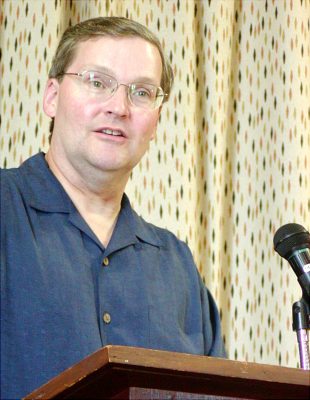 U.S. Congressman John Doolittle covers a wide range of national and local issues in his speech to Big Valley residents last Tuesday in Bieber’s Veterans Memorial Hall. “It’s good to be back in Big Valley. … I always feel so privileged to represent this part of the state of California,” he said in his opening remarks.
U.S. Congressman John Doolittle visits Big Valley
Remarks made by Republican U.S. Congressman John Doolittle to an audience in Big Valley last Tuesday were enthusiastically received by more than 50 people who attended.
Sponsored by the Big Valley Chamber of Commerce and held in the Veterans Memorial Hall in Bieber, the congressman’s speech was preceded by a potluck dinner and comments from Modoc County Supervisor Dave Bradshaw and an introduction by local businessman Carl Parks.
Doolittle’s remarks ranged over a number of national and local issues, but he began his speech with a salute to his constituents. “It’s good to be back in Big Valley. … I always feel so privileged to represent this part of the state of California. It’s a beautiful part that’s unknown to most of the world,” he said. “The great thing about rural America is the people. They’re real America. That’s why it’s such a privilege to represent you.”
His first policy comments focused on the economic devastation seen locally in recent years.
“Even though we’ve been so devastated by these extremists who just about killed off logging in most of the national forests, I’m surprised these communities look as good as they do, to tell you the truth,” he said. “It was really a relief for me to get back … and realize that they didn’t just fall apart. They’ve been able to keep going. And even here, I’m pleased to see things are looking good.”
Noting that economic development seemed to be slowly returning to Big Valley, Doolittle said, “I’m encouraged to hear we’re getting a power plant going and maybe you’re getting a new mill here. That’s a great thing for this area, and I’m really delighted to hear it.”
He specifically noted that the use of biomass from the local forests should be a priority.
“I think that’s essential to solving the problem in the national forests, which are in their worst condition in over 100 years thanks to the Sierra Club and other extreme, liberal groups which don’t believe that we should cut any trees in the national forest. They are the ones that are responsible for the terrible condition of these forests. They’re at their worst point, ever, in our lifetimes.”
National security and terrorism were next on Doolittle’s agenda. “As your representative in Washington, I’ve tried to promote things that build up our national security,” he said, pointing to the turmoil in the Middle East, Iraq, Iran and North Korea. “I must say, I’m pretty sympathetic with Israel. I’m not hoping for a cease-fire. I hope Israel takes care of the problem to the best of their ability. I plan to back them up with my vote on that.
“It’s a very difficult world we live in,” he said, continuing in that vein. “In World War II, everybody knew who the enemy was, and everybody knew that the number one goal was to defeat the enemy and everybody sacrificed for it.”
He also spoke of a “rebuilt American military,” and the planned antiballistic missile defense system, started in the Reagan administration.
“We’ve just about turned the corner on that, where it actually is something that can be utilized,” said Doolittle. “As you watch the news every morning about the rockets that Hezbollah is firing at Israel, you can imagine that it might be good to have a little protection against that kind of thing — especially as countries like North Korea and Iran continue perfecting their ability to fire missiles and deliver them farther and farther away. … We need that protection.”
Saying, “I also believe that we’re trying to spend your money wisely,” he observed that for the first time in 19 years non-defense discretionary spending was cut in the final budget bill.”
Doolitte also noted that Congress reduced the growth rate of mandatory spending.
“You never hear about it, so I’m going to tell you about it,” he said. “This is where two-thirds of the spending occurs in the federal government. It’s the most difficult to contain.”
He also used the occasion to criticize Democrats for opposing cuts in the capital gains tax rate and the dividend tax rate as well as the personal income tax rates.
“Almost every single one of them voted against the tax cuts,” he said. “Those have made a huge difference for the fiscal stability of this country. In fact, last year federal revenues increased 14 percent. So much money is coming in this year, their projections on revenue growth had to be revised (upward), and the deficit went down almost another $40 billion.”
Others of his remarks ranged widely over the war on terrorism in general, progress in Iraq, border security, immigration, pork barrel spending, alternative energy and energy independence.
“I’m tired of being dependent on these dangerous parts of the world,” said the congressman. “As long as petroleum is our main source of energy, we’ll never get away from it.”
Doolittle expressed optimism regarding the reauthorization of the Secure Rural Schools and Communities Stabilization Act, which provides needed funds to county schools, road departments and RAC projects. “I think … we’re going to get it at least extended for another year (while we) work on a more permanent solution. We feel very strongly that’s important to get resolved.”
Funding for the act would remain “at the same levels,” he said.
Referring to this act as a temporary fix for the lack of revenue to local coffers from timber sales on national forest lands, he added, “The best solution would be to resume the multipurpose use of the public lands and resume the logging in the forests, like we used to have.”