Judge rules ‘exclusionary rule’ does not apply in Westwood man’s case, questions deputy’s ‘conscious and reckless disregard for the truth’
Several important court cases uphold arrests and searches by law enforcement if the officers can show they acted in good faith despite depending upon incorrect information in carrying out their duties.
Visiting Lassen County Superior Court Judge Linda R. Clark didn’t accept Lassen County District Attorney William Ross Helmbold’s exclusionary rule arguments last week in the case of Westwood’s Anthony Kauwe, who faced more than two dozen felony charges and potentially 22 years in prison if convicted.
Clark granted a defense motion to suppress evidence seized in the case including; “Any and all statements made by the defendant after arrest or in custody based upon that arrest — 55.9 grams of methamphetamine and a digital scale with white residue seized from the defendant’s person on Feb. 24, 2024; and one live .9 mm cartridge, one live .223 caliber cartridge and one expended .357 caliber casing seized from the defendant’s person on Feb. 24, 2024.”
According to the judge’s ruling, “The evidence establishes without conflict that on Sept. 28, 2022, a criminal protective order was issued … restraining the defendant from any contact with the protected party, Angelina Abney, and that the protective order was modified on Jan. 23, 2024 to remove the no contact provisions and allow peaceful contact … On the record, it is clear that the arrest for a violation of a no-contact order was made without a warrant and without probable cause.”
The judge also ruled while Lassen County Sheriff’s Deputy Traetz’s actions could be covered by the exclusionary rule (relying on incorrect information from CLETS), “the situation is complicated by the actions of Deputy Falchetta, who was present and knew or had reason to know that the CLETS information was wrong.”
Based upon Clark’s ruling suppressing the evidence, Helmbold then asked the judge to dismiss the case.
Lassen County Sheriff John McGarva declined to comment on the matter, but he did say an investigation into the case has begun.
Witness credibility findings
The judge called the credibility of the deputies’ testimony “a significant issue” in this case.
The judge found Traetz to be credible, but she found Falchetta “appeared very nervous and frequently volunteered information that was non-responsive and self-serving in that it deflected responsibility for critical aspects of the investigation and arrest to Deputy Traetz … Deputy Falchetta’s testimony was often inconsistent with earlier statements he had made … and sometimes changed throughout the course of his appearance … Because of the number and nature of those inconsistencies, the inherent implausibility of his testimony in important matters and his attitude and demeanor, this court is not persuaded that his testimony regarding this case is reliable in many respects.”
The judge also noted Falchetta failed to appear pursuant to a subpoena at 8:30 a.m. Jan. 6, at 1:30 p.m. Jan. 6 after rescheduling, at 8:30 a.m. Jan. 7 “although he had confirmed receipt of the subpoena and his scheduled appearance with the district attorney … It was only after his commanding officer was contacted, deputies were sent to his home, numerous efforts were made by the district attorney and Deputy Traetz to contact him, and after this court’s ultimate indication that a body attachment was going to issue, did he finally appear at 10:30 a.m. on Jan. 7. He offered no explanation for his failure to appear.”
The judge also questioned Falchetta’s actions — “Under these circumstances, any reasonable and objective deputy in his situation would have believed that the CLETS entry relating to the CPO in this case was erroneous, meaning no probable cause to arrest the defendant and would have taken additional steps to ensure its accuracy … On the entire record, however, this court concludes Deputy Falchetta actually manipulated the situation in a way that virtually guaranteed Deputy Traetz would arrest the defendant that night … He never told Deputy Traetz that he had confirmed the original CPO was modified to peaceful conduct but never updated in CLETS. He didn’t mention multiple incidents in which it was determined that the CLETS entry had not been modified over several months, or that he had never taken any steps to have it corrected or to confirm it had been updated. These actions and omissions by Deputy Falchetta are the moving force behind the constitutional violation here … The reasonable conclusion drawn from all the evidence is that Deputy Falchetta knew that the order was for peaceful contact only, knew it had not been corrected in CLETS and that he could and did nonetheless effectuate the arrest and search of the defendant by another deputy who was not aware of all the facts. In doing so, Deputy Falchetta acted with conscious disregard of the rights of the defendant and engaged in the type of grossly negligent or deliberate law enforcement conduct that the exclusionary rule was developed to address.”
Information about the case
A criminal protective order was issued against Kauwe Sept. 28, 2022 restraining him from having any contact with the protected party — Angelina Abney, his girlfriend. The order was modified Jan. 23, 2023 to a peaceful contact order. But that modification was never placed in the CLETS system. (California Law Enforcement Telecommunications System. It’s a network that gives law enforcement agencies access to information from state and federal databases.)
Helmbold argued the officer’s reliance on information that the original order was still in force should allow the search and warrantless arrest to stand. He also argued the deputies could have arrested Kauwe for resisting and obstructing a peace officer without using the inaccurate information from CLETS.
The judge also found no evidence to support Kauwe’s arrest for resisting.
Sometime after the original order, Deputy Mowatt encountered Kauwe and Abney and “somehow” learned the order had been modified. He did not arrest Kauwe, but he did make note of the encounter into the official database where it was later seen by Deputy Falchetta.
Falchetta also had prior contact with the couple and contacted dispatch to confirm the protective order. He received a copy of the original order, but based in Mowatt’s notes, he did not arrest Kauwe.
A few days later, around May 16, 2023, Falchetta again inquired about the order with dispatch. The dispatcher contacted the court, and the court send an email to Falchetta informing him of the January 2023 modification, including a copy of the judge’s minute order.
Eight months later, Feb. 24, 2024, Falchetta saw Abney’s car near a storage unit. He said he didn’t see anyone else in the area except a “short person or a person slumped down in the driver’s seat.” He did not investigate, but instead assisted Traetz on a brief traffic stop.
According to the judge’s order, “When that matter was completed, Deputy Falchetta told Deputy Traetz he had seen a car connected to Ms. Abney and the defendant at the storage facility, that Ms. Abney had an active CPO, and that the defendant had a history of physically resisting law enforcement. Deputy Falchetta suggested to Deputy Traetz that they return to the storage facility to investigate a possible CPO violation, and they proceed to that location in separate patrol vehicles.”
When the deputies arrived, they observed Kauwe and Abney seated in a vehicle in front of a closed storage unit.
Traetz said he was investigating a possible CPO violation, handcuffed Kauwe and put him into a patrol vehicle. Traetz and Falchetta told Kauwe and Abney they would double-check the status of the order, and both Kauwe and Abney insisted the order had been modified. They explained the order had been modified a year earlier and that they had had three encounters with law enforcement in which officers determined the order had been modified and they had been released.
According to the judge’s order, “Deputy Falchetta never told Deputy Traetz he had previously confirmed that the CPO had been modified to a peaceful contact order the year before based on the minute order and the court clerk’s email. Deputy Falchetta did not warn Deputy Traetz that he knew the order had not been corrected in CLETS at the time of the modification, or by the time Deputy Mowatt encountered the defendant, or by the time Deputy Falchetta had his prior encounter with the defendant or by the time on May 16, 2023 when he saw the minute order. Deputy Falchetta never told Deputy Traetz that the CPO from CLETS received from dispatch that night was the same one he inquired about in May 2023.”
Relying on good faith, Traetz arrested Kauwe for a violation of the protective order that was no longer in effect. During a subsequent search, Kauwe was found in possession of methamphetamine, digital scales and ammunition.
From the LassenNews.com archives
March 12, 2024
Westwood felon faces at least 26 new felony charges
An investigation by the Lassen County Sheriff’s Office following contact with a felon allegedly in violation of domestic violence order resulted in a slew of new felony charges.
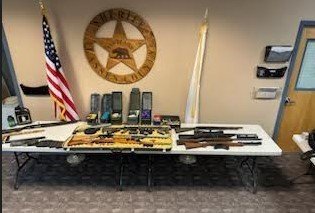 Some of the items seized by the Lassen County Sheriff’s Office during an investigation into a Westwood man last week that also turned up explosives.
According to a statement from the LCSO, deputies working proactive patrol responded to a Westwood storage unit Saturday, Feb. 24 during which they contacted Westwood resident Anthony Kauwe.
During the course of their contact, deputies learned that Kauwe was in violation of a domestic violence protective order, and they placed him under arrest. Kauwe was searched following the arrest, and deputies discovered Kauwe in possession of a controlled substance, ammunition and tear gas. Deputies also confirmed Kauwe was a convicted felon, and he was arrested on multiple drug and weapon-related charges.
On Saturday, March 9, deputies executed a search warrant on Kauwe’s storage unit where deputies discovered several firearms, a large quantity of ammunition, fentanyl, scales and explosive devices. The Shasta County Interagency Bomb Squad responded, evaluated the explosive devices and took possession of them for proper disposal. Kauwe remains in custody at the Lassen County Jail.
The LCSO forwarded the case to the Lassen County District Attorney’s Office for prosecution on the following charges: 13 counts of felon in possession of a firearm, 13 counts of possession of an explosive device, possession of a stolen firearm, possession of a loaded firearm while in possession of a controlled substance, possession of an assault weapon, felon in possession of a flare gun, felon in possession of ammunition and possession of narcotics.
The Lassen County Sheriff’s Office appreciates the hard work of the deputies who handled this investigation. In addition, the office thanks the Shasta County Interagency Bomb Squad for its assistance.