Tuesday, Feb. 6, 2007 • County says tests on possible wastewater health hazards near Richmond Road are inconclusive
Publisher’s note: This story originally appeared in the Tuesday, Feb. 6 edition of the Lassen County Times.
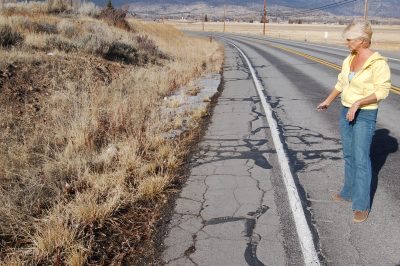 Gioia Lee, who owns property across Richmond Road from the Arnolds and the Assembly of God Church, examines a new seep that came to the surface last week. There has been no precipitation recently. Geologist Charles Watson and Lassen County Environmental Scientist Alan Jones both said this seep is probably natural and not connected to the church’s septic system.
Sometimes the experts don’t agree — even about a potentially serious public health hazard.
Chester geologist Charles P. Watson said he suspects a wastewater treatment system at a Richmond Road church has failed and created a dangerous seep down slope. The geologist also has concerns with a leach field right across Richmond Road that serves the Susan Hills subdivision.
Watson said he’s concerned the contamination may pose a serious public health risk, and he wants the county public health department to work with him and the landowners to come up with some definitive answers as soon as possible.
Despite some provocative numbers generated from his samples and subsequent biological and chemical analysis conducted by a Reno laboratory, Lassen County’s Public Health Department said the results of its independent investigations are inconclusive whether the sites pose any public health hazard at all.
In fact, Lassen County Public Health Director Doug Ames not only questioned the validity of Watson’s collection techniques, he said without positive proof of a system failure that would “stand up in a court of law,” the county cannot take action and order a landowner to make repairs.
He said his office has investigated some of these allegations over a number of years, and he remains unconvinced about the systems’ alleged failures.
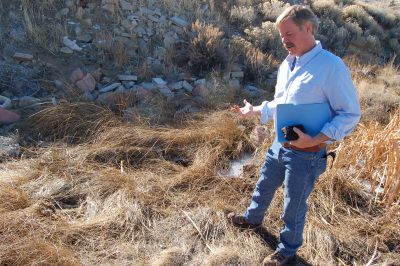 Geologist Charles Watson stands next to the Arnold seep. The Assembly of God’s leach field is about 30 feet away under the landfill in the background.
Richmond Road resident Gioia Lee, a property owner who hired Watson to investigate possible contamination on her property, has raised public health concerns regarding wastewater possibly spreading from a leach field that serves the Susanville Hills subdivision located on an easement on her property. The leach field was on her property when she purchased it.
She’s also concerned about a seep on property owned by Ernie Arnold, another Richmond Road resident. That seep is located below a landfill area approximately 30 feet from a leach field the serves the Susanville Assembly of God Church.
Lee claims water from this seep eventually runs off onto her property and contaminates it. She contends contamination from the Arnold seep and the Susan Hills leach field has sickened both humans and animals living on her property.
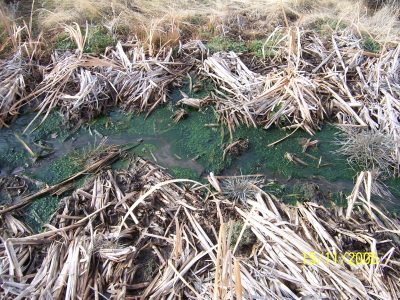 The presence of bright green algae suggests the water in this seep contains a large amount of organic matter that could come from a wastewater system.
She said she’s spent more than $28,000 so far on geological tests, numerous biological and chemical analyses, medical and veterinarian bills and despite all the results she says suggest her property is contaminated, she can’t spur the county’s public health department into action.
In addition to complaining to the Lassen County Public Health Department about her concerns, Lee said she’s filed complaints with a wide variety of agencies including the California Governor’s Office, the California Public Health Department, the Federal Bureau of Investigation, the United States Environmental Protection Agency, the California Environmental Protection Agency, the California Attorney General’s Office, the Department of Justice, Lassen County Supervisor Bob Pyle, the Lassen County Grand Jury and the California Regional Water Control Board, Lahontan Region.
Lee also is corresponding with the Susan Hills Water District, members of its homeowner’s association regarding the alleged contamination issues, repayment of her costs and with a local escrow company regarding alleged fraud involving the purchase of and the title to her land.
Yet another seep suddenly appeared last Monday along Richmond Road in front of the church, but Watson said that seep is natural and not related to the church’s septic system.
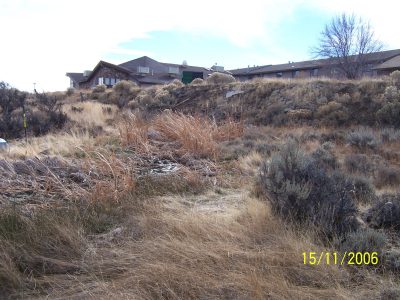 The Susanville Assembly of God Church sits just beyond the landfill area that contains its expanded septic leach lines.
Arnold seep
The most allegedly contaminated site tested by Watson is located just below a landfill and about 30-feet from a leach field that serves the Assembly of God Church on Richmond Road.
Troy Stein, the church’s pastor, said the church has cooperated with county officials in all their investigations, but there is no evidence the church’s treatment system is the cause of the seep on the Arnold property. He said if the county told them there was a problem caused by the church, it would be corrected immediately. The county hasn’t made such a determination.
“We’re a church,” Stein said. “We’re about people. We don’t want to hurt people, and the county says we’re not.”
Stein said Ames has come by the church weekly to examine the situation. He said the county health department even put dye into the church’s septic system in order to track any possible leak, but the dye never showed up in the seep or anywhere else, suggesting the church’s septic system is sound. Stein said Ames has told him there’s no leak. Period.
“From what we understand we have zero problems at this time,” Stein said. “We’re very satisfied with the county’s work.”
Ames said the county would have no reason to protect the church, and if there were a problem with its septic system, the county would order the church to repair it. He said the county can’t find a failure in the church’s system, and unless a definite problem is discovered, the county can’t order the church to make a repair.Arnold, who owns the property the seep was discovered on, said he initially was concerned the water in the seep was coming from the church’s septic system, but he’s no longer worried about that. He said the county has convinced him the two — the church’s septic system and the seep on his property — are not related in any way.
“I’m pretty satisfied with the work the county’s done,” Arnold said. “I guess I’ve got a little polluted water, but it seems to be groundwater.”
Ames said when Watson took his water samples near the seep, the water he used contained surface soil, and that skewed the results he got from the lab.
According to Ames, the seep is not caused by a leak from the church’s septic system, but rather it is groundwater that bubbles to the surface and is then contaminated by animals such as deer. Ames noted there are deer pellets in the area around the seep.
He said when Watson scooped out a hole in the ground to take his sample, the water in the hole contained dirt and soil and whatever else was on the ground. He said the introduction of such elements into the water sample skews the results and makes any analysis of the groundwater unreliable. Because the methodology is flawed, Ames said, the results also are flawed as well.
Such talk absolutely infuriates Watson.
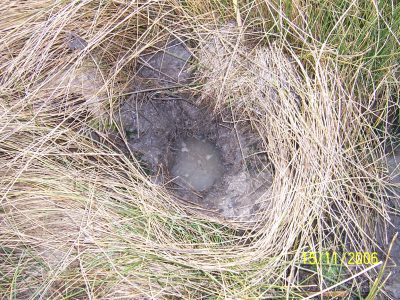 This is one of the holes geologist Charles Watson dug for a water sample near the Arnold seep. According to Lassen County Public Health Director Doug Ames, the water in this hole, God #1, has been contaminated by the dirt and soil inside it and therefore any subsequent test results are invalid.
“The demonstrative results from the laboratory analyses, the proximity to the leach field, and the poor soil conditions suggest this is a significant public health problem,” Watson said. “It saddens me to learn of the cavalier attitude of those charged to ensure our safety from problems likes these.”
According to Watson, the numbers he acquired at the seep are staggering. He characterized them as “off the scale” and said if a small child climbed down the side of the landfill from a playground at the top of the hill, got into the water and then rubbed his eyes, a dangerous or even fatal illness could develop from the bacteria the child might be exposed to.
Watson said there were children’s toys in the seep at one time, but now they have been removed.
Alan Jones, an environmental scientist with the Lassen County Public Health Department, said he was familiar with the Arnold’s seep. He said he’s been an environmental scientist for 17 years — including serving the past 12 years in Lassen County.
Jones was willing to discuss every contention in Watson’s report regarding the seep on the Arnold property.
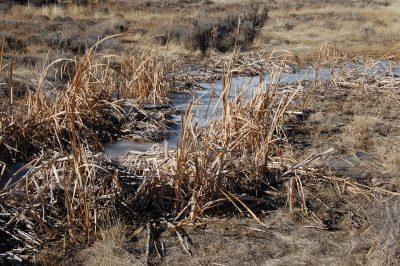 Even in the middle of January, water from this seep makes its way to the surface and freezes on the Arnold property, adjacent to the Assembly of God Church facility.
According to Watson’s report, dated Nov. 28, 2006, Arnold requested the geologist perform “surface water sampling” on the property due to “suspected surface seepage from a waste water disposal system servicing the neighboring property … owned by the Assembly of God Church.”
Watson reported, “Currently there is a prominent water seep flowing out from the base of the fill in close proximity to the location of the church’s sewage disposal system. Cattails and tall grass have been growing in the seep for years and green algae and other micro-plant growth is widespread. There is a light septic odor, which increases when the soil beneath the saturated area is disturbed. The seep extends for more than 100 feet down slope from the suspected source toward your well.”
Watson advised Arnold to have his well tested for possible contamination from the seep.
Watson claimed when he asked the health department for the records regarding the church’s septic system, he was shown a partial set of plans that did not include percolation tests or anticipated flow calculations.
Jones disagreed. He said county records show Ray Engineering conducted tests on the church’s property in 1982 when the parcel was created. A set of plans for the original system was filed in 1984 or 1985 when the system was built.
He added a second set of plans, including flow calculations, was completed when the system was expanded in 1995 due to expansion of the church.
Jones said Watson might not have been shown the entire set of plans because of the way he made his request to county staff.
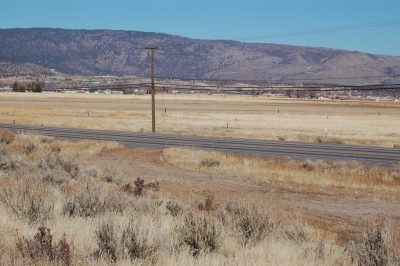 Geologist Charles Watson installed eight monitoring wells on the Lee property, located across Richmond Road from the Assembly of God Church, in order to test the integrity of a wastewater leach field that services the Susan Hills subdivision.
Watson wrote, “Lassen County Environmental Health Department was made aware of the suspected problem in 2003, and according to conversations with their staff, performed a tracer study to see if the Susanville Assembly of God Church’s sewage disposal system was the source for the surface manifestations. Apparently, the study was inconclusive, but upon requesting a copy of the report, no documents were on file.”
Jones again disagreed with Watson’s conclusions.
He said he thought the tracer study was conducted in 2004 after a complaint regarding a leaking fire hydrant was filed. He said when the county investigated, staff discovered the problem was much larger than simply a leaking fire hydrant. County staff discovered an underground water main that supplied the hydrant had ruptured. The leak was so large he said staff members on site could hear the sound of water flowing underground. Once the broken pipe was repaired, the water leak nearly disappeared.
To ensure the water wasn’t coming from the church’s system, Jones said dye was added to the church’s wastewater system.
“The dye never did come out,” Jones said.
Jones said there are notes in the file regarding the dye process that include “who we talked to and what we did,” but he said there was no report filed because there was “no one to give a report to.”
The county couldn’t give Watson a copy of the report on the dye testing because one was never written. So, when Watson asked to see the report, there simply wasn’t one to show him.
Watson also complained county staff did not participate in his reconnaissance and sampling session in November 2006, despite a request they participate. Watson said the county agreed to be on site during the sampling.
Jones acknowledged the reconnaissance and sampling session was a “set up thing,” but he said county staff advised Watson they would be unable to attend when other commitments arose. He said the county told Watson to continue without them. The geologist also complained the church denied his request to have access their property.
According to Watson, parts of the church’s system are covered by pavement. The geologist said county building codes prohibit paving above septic systems. He also said additional fill apparently was added to some of the parking areas. He said some of the fill near the seep might even encroach upon the Arnold property.
According to Watson, a septic system covered by a parking lot cannot function correctly.
“I’m not sure about that,” Jones said about Watson’s claims the church’s septic system had paving on top of it.
He said in 1995 the system was not paved over. He said in 1984 there was “a notch in the pavement” that went around the original septic system.
Jones said the county has no evidence either septic system has been paved over.
Jones noted hikers and other outdoorsmen frequently are advised not to drink untreated wild water due to the possibility of bacterial contamination. He said the water may be pure at its source, but once it comes in contact with the soil, it can become contaminated. He agreed with Ames that once Watson allowed the water used for his samples to come in contact with the soil, the results of any testing would be suspect.
He said normally a geologist would drill a sample well with concrete casings to ensure bacteria in the soil did not contaminate the water.
Jones also noted the numbers at one of Watson’s hand-dug holes near the seep were high but the numbers at the other hand-dug hole were low.
Given the disparity in the numbers and the alleged questionable methodology employed by the geologist, he said it would be impossible to be 100 percent sure the contamination in the seep came from the church or from the soil and sentiment.
In addition, the county’s dye test of the system revealed no leaks in the church’s system.
Finally, Watson noted a new seep that appeared Monday afternoon on Richmond Road below the church. No water quality testing has been completed on that seep as of deadline.
Jones said he didn’t know about the newly discovered seep, and didn’t know if that was really a new seep or one that appears periodically over the years. In any case, he said there is no sewage system on the Richmond Road side of the church.
Watson examined the new seep and said he didn’t believe it had any relationship to the church’s septic system.
Jones noted there is another huge, naturally occurring seep just down Richmond Road from the church.
Watson’s numbers at the most contaminated for the two sites near the Arnold seep, which he named GOD No.1, are: E. Coli Colilert Quanti-Tray, >2419.2; Enterococcus- Enterolert, >2419.2; MBAS Surfactants, 0.14; Nitrate-N ion Chromatography, 10; and, Total Coliform Quanti-Tray, >2419.2.
E. coli is a bacteria that grows in the lower intestines of mammals. This type of bacteria is frequently referred to as “gut flora.”
Enterococcus is a form of the streptococcus bacteria.
MBAS surfactants are chemicals included in detergents that alter the surface tension of water and allow it to better carry away dirt.
Most wastewater treatment facilities release nitrogen as nitrate as part of the “nitrogen cycle.” Nitrates can be a food source for algae.
Coliform bacteria originate as organisms in soil or vegetation and in the intestinal tract of warm-blooded animals (fecal coli). This bacterial pollution may be caused by runoff from woodlands, pastures and feedlots, septic tanks and sewage plants, or animals and wild fowl.
The geologist said a properly functioning septic system should not leak any water, but regardless of the source of the contamination, these numbers represent a public health hazard that should be addressed immediately.
Watson’s samples were handled through accepted chain of evidence procedures and eventually tested by Sierra Environmental Monitoring, Inc., of Reno, Nev.
A company spokesman declined to comment on the numbers in their analyses because such comment could violate a client’s confidentiality. The spokesman also declined to comment on what such numbers might suggest if the company or one its clients were not involved in such analyses.
The spokesman referred the question to the California Department of Public Health. The state agency said it does not review data from outside sources.
Susan Hills leach field
Despite Lee’s claims her property is contaminated from Susan Hills leach field, a report by Watson, found, “laboratory results are inconclusive at this time that contamination has extended outside the prescribed easement. Several factors can be attributed to the results supporting both for and against the contamination.
Key contamination indicators such as E. coli and MBAS surfactants were lacking, but this may be a result of the depressed groundwater elevations observed the time of year the samples were obtained. Alternatively, elevated nitrate, enteroccous – enterolert and total coliform are supportive of contamination outside the easement.”
The geologist suggested further testing during a wetter season when groundwater levels rose. There has not been much wet weather this winter.
Watson installed eight monitoring wells outside the easement on Lee’s property on Oct. 31.
According to Watson’s report, “the monitoring wells were installed to test for contamination outside the easement in respect to the Susan Hills Estates community leach field.”
Watson also reviewed the history of the leach field system.
The geologist recommended, “a Registered California Land Surveyor locate the actual prescribed leach field easement on the ground and that forensic geological work located the actual construction of the leach field beds and conveyance lines. Furthermore, we recommend that detailed soil profiles and percolation tests be conducted to assist in understanding the soil conditions of the property. According to our Oct. 5, 2004 preliminary report, these characteristics were grossly misrepresented in the initial design and construction of the leach field.”
In addition, Watson wrote there was no evidence of maintenance “for some time and perhaps several years.”
He also said there was no documentation available as to how many homes or facilities are attached to the system, and “knowing the load on the system could prove valuable in understanding why the system may have failed.”
The California Regional Water Control Board, Lahontan Region, has jurisdiction over wastewater issues in Lassen County, but Chief of the Northern Basin Regulatory Unit Alan Miller said that responsibility has been transferred to the Lassen County Health Department.
He said the water board was involved in the initial construction of the wastewater system for the Susan Hills subdivision, but once the project was completed and approved, the jurisdiction was handed over to the Lassen County Health Department.
“We have a long relationship with the Lassen County Health Department,” Miller said. “They primarily oversee the installation and operation of septic systems at private residences and most small community developments. They are not responsible for industrial wastewater. In the late 1980s or the early 1990s we formalized an agreement with the Lassen County Health Department to oversee septic systems. We are aware of the concerns and complaints of the property owner, but we weren’t able to verify any information she’s provided to date. We think the county should take the lead if there’s a wastewater problem.”
Susan Hills Water District Board President Steve Rose said the district is not aware of any problems with its system.
“If somebody tells us we have a problem,” Rose said, “we’ll fix it. But as far as we know, nothing’s broken.”
Rose said it’s difficult for the district to respond to such frivolous allegations that lack substance and are not in the form of a legal document.
“We’re not trying to cover any thing up,” he said. “We’re waiting for some of her figures to be substantiated by some government agency. They’re the ones who will tell us, and then we’ll fix it. But as far as we know, there’s nothing wrong with us.”
Responding to the allegation the district did not properly maintain its system, Rose said a contractor replaced some lines at the top of the system a year or so ago. He said the district would not repair its system if it weren’t broken.