Tuesday, April 14, 2015 • Susanville Indian Rancheria works to save languages
The Susanville Indian Rancheria is working to continue teaching and learning the languages of the local tribes through accelerated learning programs, texts, dictionaries and immersion camps.
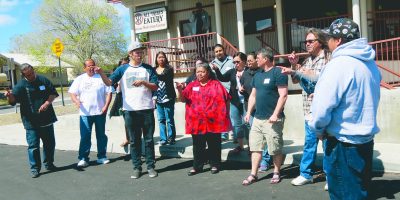 With the help of a grant, the Susanville Indian Rancheria brought in the organization Where Are Your Keys to help accelerate the learning and teaching process of the Maidu language through games and activities.
A three-year Native American Language Preservation and Maintenance grant from the Administration for Native Americans combined with funds from the Susanville Indian Rancheria allowed organizers to collect text, recordings and other items for the Maidu language.
Now, the grant is nearly complete, and Donna Clark, language program coordinator, has worked with others from local tribes to help maintain the original languages for each tribe.
“It’s really vital for the strength of the tribes,” said Clark. “It’s going to be a lot of work.”
Earlier, the Rancheria had been awarded a grant to conduct a survey, which measured the standing of the languages of the four tribes in the Susanville Indian Rancheria: Maidu, Northern Paiute, Pit River and Washoe. Clark said the surveys showed a clear interest by tribal members to maintain the languages.
One of the most recent facets of the attempt to teach the languages was bringing in the organization Where Are Your Keys? which helps people learn a language as they teach it in a streamlined process, according to Evan Gardiner, the organizations developer.
“Where Are Your Keys is a collection of techniques used for rapidly reaching proficiency in a target skill, such as Spanish, volleyball or old-style fiddling (although to date, WAYK has been used mostly for acquiring languages),” read the organization’s website. “Where Are Your Keys?” players believe that even the fastest process can be made faster, students need not wait to teach others what they know, and fluency is easy. Everyone learned a language once, without the use of textbooks or dictionaries, and given the right tools, they can do it again.”
From Monday, March 30 to Saturday, April 4, the Where Are Your Keys representatives worked with teachers from local tribes to learn effective and accelerated ways teach the language. The participants partook in activities that taught the basics of the language easily, in a fun manner and with minimal English. There were no books or texts in the demonstrations.
According to Clark, she hopes for more people to become fluent in the languages of the tribes.
She said there is currently one person left who is fluent in the Maidu language; a 96-year-old Greenville resident.
Currently, Danny Manning has been meeting with the fluent speaker, learning the language and hearing stories of her life. According to him, he has enjoyed taking what he has learned from the fluent speaker and sharing with whoever wants to learn.
Clark said she believed the last time the native languages of the tribes was freely spoken and encouraged outside of private homes was nearly 50 years ago.
Now, she hopes to target youth and encourage them to learn and keep the languages of the tribes going.
She hopes there will be immersion camps in the future where participants could spend up to a week just speaking the language they are learning, and a website for the members to use.