CDFW hosts a Monday meeting on the wolf crisis in Northern California, but denies ranchers a seat at the table
The California Department of Fish and Wildlife holds a meeting on Monday to discuss the wolves and the state’s Wolf-Livestock Compensation Plan, but according to Chad Dibble, the deputy director of the Wildlife and Fisheries Division of the California Department of Fish and Wildlife, the state’s cattle producers are not invited.
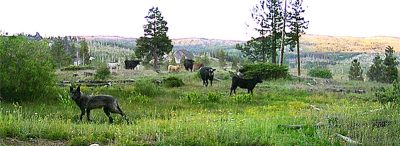 In this trailcam photo, a wolf is seen near rancher Richard Egan’s cattle near Lone Rock.
In case you haven’t noticed, the wild wolves are flourishing in California.
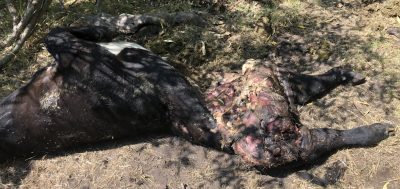 One of Richard Egan’s calves — killed by wolves.
Why BEY03F — a female grey wolf, born in Northern California in 2023 — showed up in Los Angeles County last week when her radio collar pinged her location, but she hastily retreated back into the wilds of Sequoia National Forest.
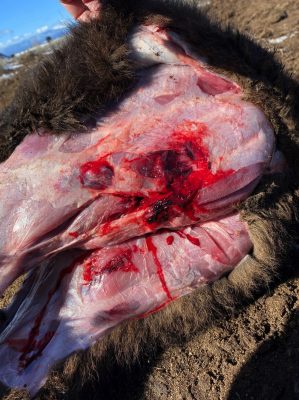 There is a disturbing side to wolves returning to California. Here are remains of a calf killed by wolves — a loss of income from which the rancher can never recover.
Wolves killed nearly 200 livestock animals in 2025 with BEY03F’s birth pack in Sierra County making 90 of those kills. Despite utilizing a variety of recommended nonlethal methods in Sierra County, the Beyem Seyo pack became so uncontrollable and savage, four members of the pack where gunned down by government advisors.
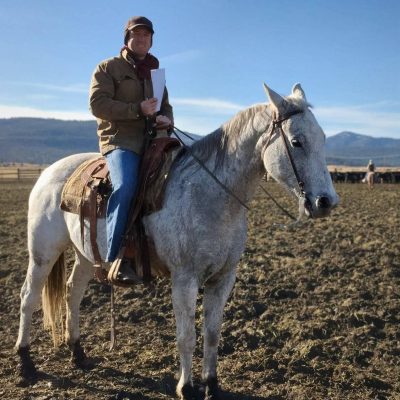 Wyatt Hanson and the family’s horse Smoke.
Wolves in Lassen County recently injured a family horse so badly it had to be euthanized.
The state put a program in place to compensate the ranchers for their losses to the predators that have been absent from the state for nearly a century, but the ranchers say that program just doesn’t work.
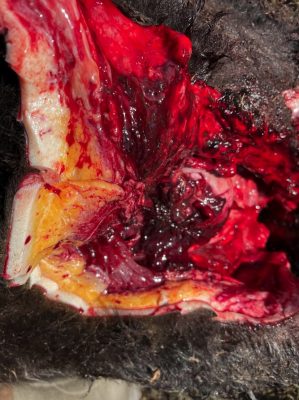 Another bloody wolf kill.
According to wildlife.com, “In 2021, the California State Legislature appropriated $3 million to CDFW to develop a Wolf-Livestock Compensation Pilot Program to help minimize the impact of wolves on livestock producers based on the following areas of need (prongs): Direct livestock loss (prong 1); Nonlethal deterrents (prong 2); Pay for presence (prong 3).
An interim program was launched to receive applications for Prong 1 in February 2022 and Prong 2 in May 2022. The pilot program for compensation of all three prongs launched in June 2023 and ran until funds were exhausted in March 2024.
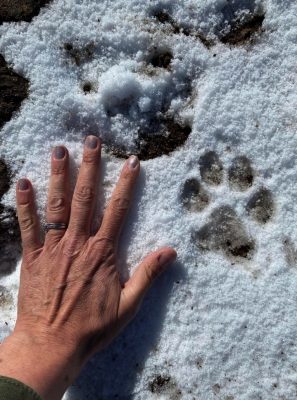 A local photographer took this photo of a wolf print believed to have been made by OR7 — the first wild wolf in California in nearly 100 years — as he traversed Lassen County searching for a mate. OR7 eventually returned to Oregon where he started his own pack. California school children named him Journey.
Eligible livestock producers received 100 percent of the $3 million allocated by the legislature. A total of 109 grants were awarded to producers with livestock in the following areas of known wolf activity: Lassen, Siskiyou, Plumas and Tulare counties.
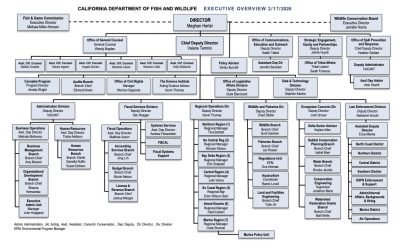
Monday, CDFW hosts a meeting to discuss the Wolf-Livestock Compensation Pilot Program, but according to an email from Chad Dibble, deputy director of the Wildlife and Fisheries Division of the California Department of Fish and Wildlife, the livestock producers are not invited to attend that meeting.
 Richard Egan
Local rancher Richard Egan wrote to Scott Gardner, Chief of the Wildlife Branch, seeking a seat at the table.
Egan wrote, “I am a Lassen County rancher that grazes in many counties of the state, most of which are directly impacted by wolves. I have had numerous confirmed depredations on my cattle dating back to the original Lassen Pack, and continue to have uncompensated losses, increasing each year. I have participated in the pilot programs administered by your department, and can tell you first hand that if your department had availed itself of producer input prior to implementing those programs, they would have had far more success, resulted in more benefit to producers and much less wasted taxpayer funds.
 A yearling female gray wolf from the Whaleback pack is released after capture and collaring in Siskiyou County. Photo courtesy of Malia Brytus/California Wolf Project
“I recently learned of your agencies plan to hold a ‘stakeholder’ meeting regarding gray wolf impact compensation, as well as other wolf program issues. I was disappointed to learn that it is being held as private meeting limited to special interest activist groups and a few select academic researchers. I am very concerned that the limited input will result in continuation of the ‘nonlethal’ narrative that failed so miserably in Sierra Valley last year. I am writing to request attendance at the meeting as I believe as an affected producer, I could provide an important perspective on the issues. I also understand that the California Cattlemen’s Association President has requested attendance, (and) I encourage you to allow that as well. The California Farm Bureau could also provide valuable input to your effort.
 OR-93, the Oregon wolf that traveled to California in 2020. Photo by Austin James, Jr., Confederated Tribes of Warm Springs
“We may disagree on the value of including the radical activist groups in your policy development, but I agree that unbiased academics can provide valuable input, and perhaps we could also agree that inclusion of genuinely affected parties could be beneficial. I would appreciate the ability to attend, and look forward to a timely response as I understand you have scheduled (the) meeting for next week.
 CDFW wolf collaring January 2025. Photo by Malia Byrtus/California Wolf Project.
Egan received a response from Gardner’s boss, Wildlife and Fisheries deputy director Chad Dibble.
Dibble responded, “Thank you for reaching out and for your continued interest in this topic. The department is planning a meeting next week to begin discussions and evaluation of the existing Wolf Livestock Compensation Program. Over the past several months (and years) the department has worked with interested parties (including you) to develop, implement and solicit feedback about the current program. We recognize there are multiple parties interested in the WLCP and that all input is valuable. However, similar to past efforts, we are beginning discussions with a subset of representative stakeholders to help get the process going. Our intent is to work with this group to develop ideas that will evolve into tangible products that we can bring forward for broader stakeholder input. As part of our initial discussions, we will be determining the timeline of this effort, what the process looks like for these parties to work with their constituents to solicit additional input, and how the department will gain additional public input prior to finalization of any changes.
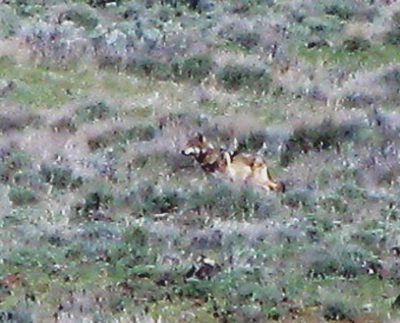 This image is the only known color photograph of OR-7. It was taken in Modoc County in May 2012. Photo by Richard Shinn, courtesy California Department of Fish and Wildlife
“The parties below, which I believe line up with your concerns regarding representation of livestock producers, have been requested to participate based on their past participation in the development of the WLCP, authority, expertise, and/or their position as a representative of multiple interested and affected stakeholders.
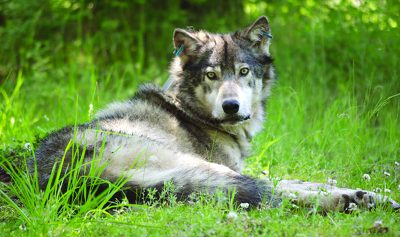 The gray wolf inspires both fear and awe. To facilitate further study, this individual has blue ID tags on its ears. Wolves have been the subject of much folklore throughout civilization. The tales range from Little Red Riding Hood, tricked by a wolf dressed up as her sick grandmother, to Remus and Romulus, brothers who founded the city of Rome after being raised by a female wolf.
“Requested parties
The California Farm Bureau (Steven Fenaroli); Cattlemen’s Association (Kirk Wilbur); CA Woolgrowers Association (Phil Esnoz); Western Landowners Alliance (Avery Shawler); RCRC (Staci Heaton); UC Cooperative Extension (Tina Saitone, Tracy Schohr); UC Berkely (Arthur Middleton, Kaggie Orrick); Defenders of Wildlife (Pam Flick); CA Wolf Foundation (Susan Dewar); Center For Biological Diversity (Amaroq Weiss); Working Circle (Karin Vardarman); USDA-WS (Jeff Flores); NRCS (Alan Bower); and FWS (Adam Johnson).
 The gray wolf was native to California. Prior to OR-7, the last known California grey wolf was shot in Lassen County in 1947. Photo by Gary Kramer, U.S. Fish and Wildlife
“We value your input and at this time encourage you to reach out to your respective representative(s) from these parties as we continue to develop this process. Should you have additional concerns or questions, feel free to reach out to me directly.
 Putting a collar on a sedated wolf.
Egan said none of those requested parties are producers or ranchers.
And Egan responded to Dibble, “I remain disappointed in your response to my request, and your continued position to exclude input from directly affected parties regarding this issue. I’ll point out again, that you have included exactly ZERO producers impacted by wolves in your proposed private meeting.
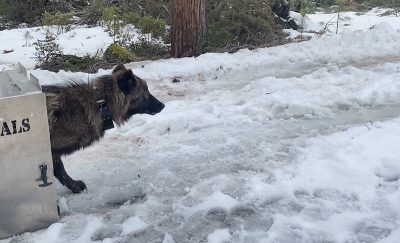 A yearling male wolf from the Whaleback Pack in Siskiyou County returns to the wild after being outfitted with a satellite collar for management and research purposes.
Rick Roberti, a Sierra Valley rancher and California Cattlemen’s Association president joined the conversation.
He wrote, “Thank you for your response to Mr. Egan’s letter concerning the Monday meeting. Although I would have welcomed an invitation to attend, I am confident that Kirk Wilbur will do an excellent job representing the CCA membership.
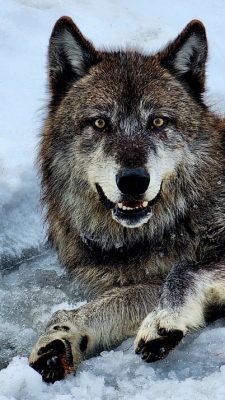 OR 85.
“There are hundreds of producers and community members directly affected by wolves who are not being represented at your meeting. Reviewing the invite list, I see several individuals for whom I have great respect; however, it is highly unlikely that many of them will ever need to seek a compensation payment in the future.
“This raises concerns for me and does not align with the realities faced by those most impacted. More importantly, it does little to strengthen what is already a fragile level of trust between the department and livestock producers.
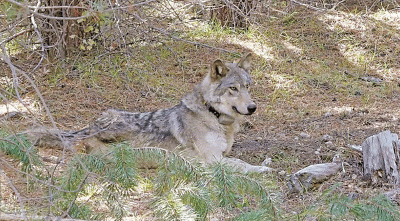 In 2020, the California Department of Fish and Wildlife reported OR54, a wolf that traveled extensively through Lassen, Plumas, Butte, Tehama and other counties, was found dead in Shasta County. Photo courtesy U.S. Fish and Wildlife Service
“I understand this is the beginning of what will likely be a long and difficult series of meetings, but this does not feel like the best way to start the process. That said, I genuinely hope progress is made and that the group makes a sincere effort to listen to those most affected by wolves.
“Livestock producers have been incredibly patient — with both wolves and your department — but we see no real changes on the horizon. In January, Wade Crowfoot stated, “we have a full-blown crisis on our hands.” Words like that should matter. Yet from the perspective of producers whose cattle continue to be attacked, nothing has changed.
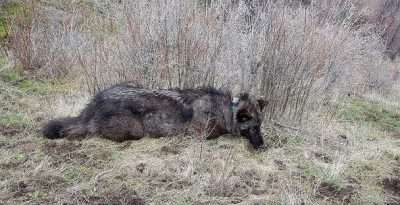 This photo of OR-59 was taken in 2017 just after he was fitted with a GPS collar. He was shot and killed north of Bieber in Modoc County in December 2018. Photo submitted
“I hope that during this meeting you will address the concerns raised by Richard Egan, as well as my own, and that you will set aside time to hear directly from livestock producers who are living with the impacts of wolves on a daily basis.”
We’re waiting along with Egan and Roberti to see if the powers that be in Sacramento will want to hear what those ranchers who actually have to deal directly with the hazards the wolves pose have to offer to the discussion.
 Government experts work on a female gray wolf pup in Lassen County.