LMUD board narrowly approves three-year rate plan
At its Tuesday, Oct. 28 meeting, the Lassen Municipal Utility District Board of Directors held a public rate hearing and approved a new three-year-rate plan that looks boldly into the future and changes the way customers’ bills will be calculated in the future.
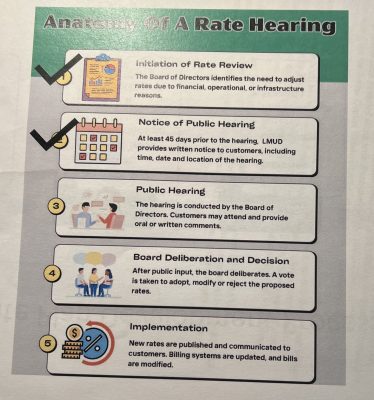
The board approved the wide-ranging plan, developed under the leadership of new General Manager Nick Dominguez, by a 3-2 vote with directors David Ernaga, Daren Hagata and Jess Urionaguena voting aye and directors Fred Nagel and Charity Moore voting no.
Moore had proposed a second motion that would have included a reduction in the kWh charge to offset the removal a portion of the 2.85 percent public benefits charge from the kWh charge to a separate line item on the customers’ bills. Due to the passage of the original motion, Moore’s alternative proposal was not considered.
According to the three-year rate plan, residential customers currently pay 19.5 cents per kWh usage, and a $30 facilities charge.
Starting in 2026 customers will continue to pay 19.5 cents per kWh usage, the $30 facility charge and an additional 2.85 percent for public benefits.
The formula changes again in 2027 and beyond.
In 2027 customers will pay a 15-cent power and delivery charge (per kWh hour usage), a 5.5-cent transmission charge (per kWh hour usage), the $30 facility charge and 2.85 percent for public benefits.
In 2028 customers will pay a 16-cent power and delivery charge (per kWh hour usage), a 5.5-cent transmission charge (per kWh hour usage), a $30 facility charge and 2.85 percent for public benefits.
 Curtis Bortle.
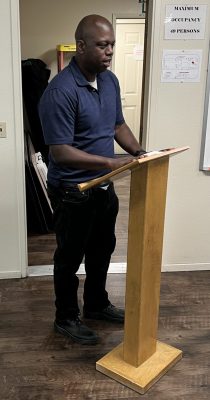
Susanville City Councilmember Curtis Bortle said, “I think I appreciate the fact that your general manager has taken a forward-looking approach … I think that’s something that been pretty absent in regards to reliability and continued power distribution that LMUD provides.”
 Patrick Parrish.
Susanville City Councilmember Patrick Parrish asked how these changes would affect a customer’s monthly LMUD bill.
Dominguez referred Parrish to a chart included in the agenda packet. According to that chart, the average LMUD customer that uses 800 kWh per month, would see their monthly bill rise by $4.45 per month in 2026, $6.97 per month in 2027 and $8.23 per month in 2028.
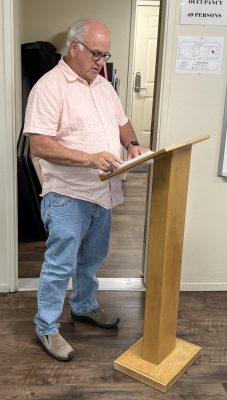
Lassen County senior statesman Jim Chapman offered his comments as well and opposed the rate plan because it did not reverse the high rates customers continue to pay now that the price of purchased power has fallen and because he thought the board should have provided more information to the public prior to this public hearing.
“We have had four general managers in five years, each with their own interpretation on how to proceed,” Chapman said. “The lack of consistency in the overall management of the district has led to the district adding more than $2.4 million to the cash balance at the end of the fiscal year on June 30. Maybe it was luck, but before you proceed with increasing rates, we need to seriously revisit the rate adjustments of 2023, now that the purchase power crisis has ended. That is why I am opposed at this time to the proposed three-year plan, and trust you will return it to the general manager for further work.”
Chapman also took exception to the way LMUD presented this information to the public.
“I am opposed to the proposed 3-year rate plan, as it is currently presented and note deficiencies in the 14401 Report that has been submitted by the general manager,” Chapman said … “In order to provide adequate testimony or comment at a hearing like this one, the information required by Section 14403.3 is essential.”
 Eigene Chittock.
LMUD General Counsel Eugene Chittock responded to Chapman’s concern that the requirements in the report cited by Chapman did not actually apply to LMUD because the district has fewer than 500,000 customers.
“If that is the case, then why are they trying to follow that process?” Chapman wrote in an email to LassenNews.com.
“I also think it was disingenuous for them to share new information in their power point presentation (at the LMUD meeting),” Chapman wrote in his email. “Much of that information should have been in the 14401 Report they released last month, giving those who care an opportunity to study and comment on.”
Chapman also squared off against Dominguez’s opinion about LMUD’s current rate charge.
“The premise that the general manager believes the baseline of our kWh charge is .195 cents is also at issue,” Chapman said. “If you review the wider record of the past five years, it would demonstrate that the baseline for the kWh rate is more like .135 or .14 cents.
“Until 2022, the price of purchased power was relatively stable,” Chapman said. “But starting in mid-2022 that began to change. During the district election in the fall of 2022, Director (Bud) Bowden faced two challengers and he made the case, with the backing of then general manager Pat Holley, that the district had kept the rates relatively low and they would continue to do so. He won re-election. Factors, driven by the drought and the aftermath of the pandemic, completely changed the direction of the marketplace. Before the ink dried on the election certificate, the board was dealing with purchased power bills that shot through the roof, and in some cases more than double what had been the case for the previous dozen years. Frequent power outages, driven by fires and stormy weather, forced the district to rely on the more expensive Honey Lake Power purchases. The net effect pushed the board to do just the opposite of what was promised in the 2022 election – raise rates, at a very rapid pace.
“With the Dec. 10, 2022, billing the kWh rate jumped to .145 cents; then the Jan. 10, 2023, billing jumped to .16 cents per kWh; the March 10 billing jumped to .165 cents per kWh, with the April 10, 2023, billing it reached .19 cents per kWh, and we finally settled at the current rate of .195 kWh on Jan. 10, 2024.
“That rate has been in place for almost two years now, even though the explosive purchased power bills have long ago returned to more historic lower levels. It is important to note that none of those increases were made following any of the 14401 Report requirements. The increases were dictated by the retrospective ‘PDCA model’ to determine the appropriate rates.”
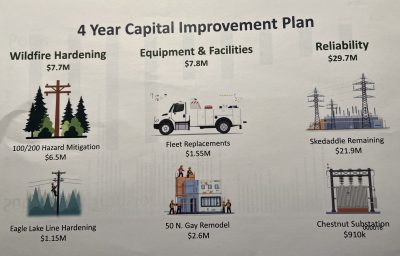 The Lassen Municipal Utility District considers a number of capital improvements over a four year period.
Chapman also expressed concern about the district’s ambitious four-year capital improvement plan expected to cost ratepayers an additional $45 million over the next four years.
“Next year we are going to be reaching the completion of the ambitious $50 million Skedaddle Project and the tie-in with the more reliable NV Energy and move away from the less reliable PG&E source to feed our power purchases,” Chapman said. “Until the dust settles next year, we won’t know what the real costs or impacts of that project will be on our day-to-day operations.
“So, it concerns me when I hear our new general manager talking about the district pursuing another $45 million in new capital improvements in the coming years, which drives the increases in the proposed rate proposal. I am not saying that these projects are not necessary, but I do feel that we need to have those proposed improvements, along with all our financial activities quantified, so that a proper judgement can be made by the board and by the public.”