Tuesday, April 28, 2009 • Utility district ponders future direction
Publisher’s note: This story originally appeared in the Tuesday, April 28, 2009 edition of the Lassen County Times.
The Lassen Municipal Utility District’s Board of Directors huddled with management and staff during a two-hour special strategic planning meeting on Monday, April 20 to plot the district’s future course.
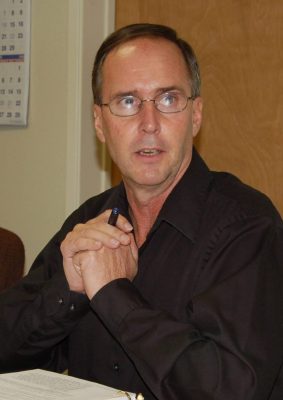 Ray Luhring.
Ray Luhring, LMUD’s general manager, led a 70-minute presentation prepared by staff that outlined a variety of directions the board might consider for the district. The presentation touched many activities and options open to the publicly owned utility district. The board took no action on the presentation, but meeting gave the board, management and staff an opportunity to discuss the district’s future.
After the presentation, the board, management and staff discussed the material for about an hour. The general manager also pointed out the district’s strategic planning process has been ongoing for several years.
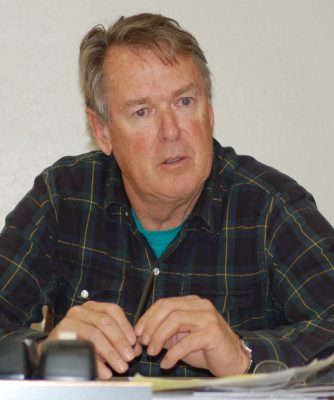 Fred Nagel.
In the past few months, Fred Nagel, president of the LMUD board, has scheduled a number of special meetings to give the district’s board, management, staff and the public an opportunity to consider a variety of topics and set the district’s future course.
Major points discussed during the presentation included the stability of power supply, industry regulation and legislative influence, utility plant infrastructure, personnel, public relations and business planning.
 Jay Dow.
Director Jay Dow said he had two problems with the special meetings held during the day. First, he said the special meetings “eat into the day’s other jobs.”
He also said the public doesn’t attend the LMUD meetings held during the day as expected.
Second, he said the board should conduct its business during regular meetings held at the regular time rather at special meetings held during the day. He said the board could schedule such study sessions during its regular meetings.
 Wayne Langston.
Director Wayne Langston agreed and said he’d like to avoid the day meetings — at least now through the summer.
Nagel said it was nice to have the special meetings during the afternoon during the winter.
Mission statement
During his wide-reaching presentation, Luhring started back at square one — suggesting a revision of the district’s mission statement to read, “To provide a superior level of reliable electric service at a reasonable price.”
Luhring said the district’s guiding principles should include perpetuating a long-term business relationship in Lassen County, maintaining a skilled work force by providing a safe work environment and paying a fair and competitive compensation, maintain local control and zealously guard the benefits of public power.
Dow also said the board needed to ask, “What do we want to be and how do we get there? We need to start deciding some of these directions. We need to look at everything and weigh the risk to reward.”
Langston said the board should be setting a direction and establishing priorities for the district.
Stability of power supply
Luhring said the district should continue to explore generation possibilities including participating in feasibility studies for projects considered and approved by the board.
The board also should continue to utilize Western Area Power Administration benefits to its maximum extent, but also explore power purchases and relationships with other power entities, work with other power agencies to develop a delivery system from or through LMUD’s franchised territory and study the economics of becoming part of Nevada Energy’s control area verses remaining with the California Independent System Operator.
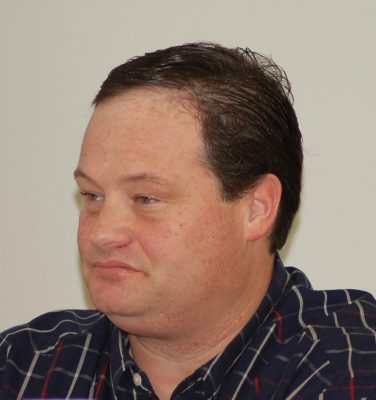 Richard Vial.
Director Richard Vial said looking into a relationship with Nevada Power should be “a top priority.”
Dow asked about the status of the district’s proposed coal-fired plant partnership with Utah Associated Municipal Power Systems.
Luhring said the plant was involved in litigation and may wind up being cost prohibitive due to carbon credits. He said the district pays about $2,000 per month to be involved with the project, but LMUD will get its money back as part of any settlement that is reached.
Luhring also said WAPA had increased its pool buying practices in order to take advantage of lower power prices.
But the general manager said because Lassen County is on the east side the Sierra Nevada Mountains, the district is more similar to those of in Nevada than those in California. He said preliminary research suggests the district could save between $3 million and $8 million a year by purchasing power from UAMPS.
Industry regulation and legislative influence
Luhring said the board and staff should continue active involvement in the industry, especially with respect to proposed and enacted legislation.
Staff members also should continue their proactive involvement as the voice of public power by maintaining memberships in committees from the California Municipal Utility Association, the Northwest Public Power Association, the American Public Power Association the Western Area Power Administration and the Northern California Power Agency.
Luhring said the benefits so such partnerships include retaining local control, having a large voice at the Federal Energy Regulatory Commission, having the ability to influence legislation and enjoying resources for a small utility district.
LMUD should continue to educate the public and elected officials regarding public power issues through monthly Ruralite articles, the district’s website, news media updates and presentations to organizations and local governing boards.
The district also should continue its active involvement in city and county planning and educate the public through employee involvement with community groups.
Utility plant infrastructure
Luhring said LMUD should update and develop multi-year plans for utility plant and equipment upgrades to improve reliability, improve efficiency, reduce line losses, replace antiquated equipment, improve economics, better forecast loads, reduce inventor through standardization and improve rate design capability.
In addition, LMUD should continue its substation plans. Since 2007, five antiquated substations have been eliminated as a result of system upgrades, and one new substation upgrade is planned which would eliminate two sub-standard substations.
One important goal, Luhring said, was to build in redundancy for system reliability.
“We really need that in Susanville,” Luhring said.
The district also should continue to track the economics of its line extension policy.
Luhring said comparing the actual costs of installations and the fees charged for line extensions was important because, “we’re probably not covering our costs.”
The district also should give consideration to energy efficient upgrades in equipment, materials and supplies and upgrade its vehicle fleet to meet fleet emission standards that take effect in 2025.
Personnel
Luhring said the district should evaluate and formulate a plan for employee attrition, evaluate the use of contractors or additional employees, continue its employee training programs, look for cost savings in the district’s employee benefits program and refine the district collective bargaining agreement with the International Brotherhood of Electrical Workers, the union that represents most of the district’s employees.
Public relations
The district’s public relations efforts are very important, Luhring said.
LMUD should convey a consistent message about the district’s goals and long-term plans and continue to develop its relationships with the media and industry outlets.
In addition, the district should develop, promote and monitor its evolving public benefits program.
Vial suggested the district’s website could be revised to allow customers to compare the district’s rates with those of other utilities.
 Theresa Phillips.
Theresa Phillips, LMUD’s energy services specialist, said the district was revising its website and redesigning its bills in an effort to help customers understand their usage and the district’s charges.
Business planning
Luhring said the district should continue to develop current and multi-year financial forecasts, identify possible business opportunities within LMUD’s incumbent authority and consolidate all its facilities into one location.
Dow said the developing a business model was the most important task facing the district.