Tuesday, April 7, 2015 • City Council narrowly approves medical marijuana cultivation ordinance
Publisher’s note: This story originally appeared in the Tuesday, April 8, 2015 edition of the Lassen County Times.
After a public hearing and nearly 90 minutes of discussion by councilmembers, the chief of police, city staff and local growers, the Susanville City Council narrowly approved waiving the first reading and introduced Ordinance 15-0997, a zoning measure that regulates the cultivation of medical marijuana within the city limits.
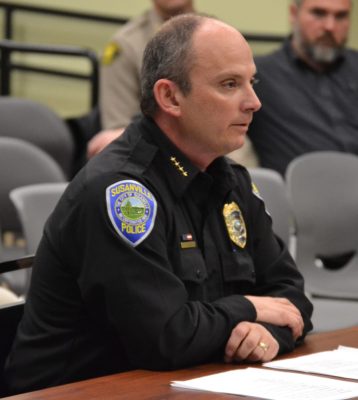 Tom Downing.
“The ordinance before you is well refined through several public meetings,” said Tom Downing, chief of police.
He said the Susanville Planning Commission reviewed the ordinance and made suggestions and revisions, and the revised ordinance was again discussed by the planning commission and then approved.
He said the commission wanted a “reasonable notice clause” regarding inspections of grow sites, allowing grows on property not zoned residential that have residences on them, security fences up to 9 feet tall, and the restriction of illegal security measures such as wired shotguns or booby traps.”
He said the planning commission also expressed concern regarding new daycare centers near established gardens, and that issue has yet to be resolved.
 Brian Wilson.
The vote was 3-2. Mayor Brian Wilson and councilmembers Kathie Garnier and Nicholas McBride voted aye while councilmembers Rod De Boer and Lino Callegari voted nay.
Wilson pushed the councilmembers to take a stand on the ordinance saying it was the fourth time the matter has come before the council, and he suggested revisions could still be made at a later date to address councilmembers concerns with the ordinance.
 Lino Callegari.
Callegari expressed his concern for the possible liability property owners might face as a result of the ordinance that requires them to give written consent to the city allowing a grow on their property. He asked city staff to research the issue and bring back a legal opinion.
“I want the property owner to be protected,” from any liability that might arise from the use of medical marijuana grown on their property with their permission, Callegari said.
He also expressed concerns from property owners regarding how a garden near their property might affect property values.
 Kathy Garnier
“If they’re concerned,” Callegari said of his constituents, “then I’m concerned.”
Garnier expressed her concern regarding the relationship between childcare providers and the gardens. According to the ordinance a garden could not be planted within 500 feet of a school, licensed childcare facility or a public park as defined in the ordinance.
City planner Craig Sanders said the city couldn’t identify many childcare facilities — especially smaller, family-run daycare facilities — because they do not reach the threshold to be identified by the state of California. For that reason, the city has no way of knowing where these smaller operations are located, and the city would approve the registration of a medical marijuana garden that might be closer than 500 feet from such an unknown facility.
Garnier also wondered what might happen if a childcare facility opened within 500 feet of an existing garden. She said she thought if the garden was there first it should take precedence.
 Jared Hancock.
City Administrator Jared Hancock said a permit for a grow would be denied if the site were within 500 feet of a daycare center, but the ordinance would not stop a daycare center from opening near a medical marijuana garden.
Expressing her concern about protecting children, she asked Hancock how the ordinance couldn’t stop a daycare center from opening near an existing medical marijuana garden, but it could stop a medical marijuana grow near such a facility.
Garnier said she thought the first use should prevail.
“As far as I’m concerned, first come gets it,” Garnier said.
 Nick McBride.
But Callegari tried to push the conversation back to the zoning issue.
“We’re not talking about medical marijuana,” Callegari said. “We’re talking about property rights. We’re talking about zoning — where and how to grow. I don’t want to deny anybody their medical rights … as long a medical doctor prescribes it, I won’t stand in the way.”
He said he had friends with cancer who got relief from cannabis. It didn’t cure them, but it helped with their symptoms.
McBride said he thought medical marijuana users should get their medical marijuana through a pharmacy.
“I don’t think the state’s done us justice,” McBride said.
He said he thought a new daycare facility should not be allowed to open near an established grow.
Wilson also called the childcare issue “a sticky one for me.”
Growers’ reaction
“Here we go again,” said Michael Mankins. “I see this as the needs of the few who are going to exercise their political might.”
He said “there are already solutions to the problems” this ordinance attempts to resolve because state law already regulates medical marijuana and any illegal use is already a crime.
“I’m quite sure it’s already a foregone conclusion this is going to get voted in,” he said. “I’d be surprised if one of you stands your ground and says, ‘No, no, no, this is a bad idea’ … Why not enforce the laws that are already in place instead of wasting all this time and energy. I appreciate everything y’all are trying to do, but it’s overboard. It’s too much. It’s ridiculous. In the end, a bunch of us are going to go out and get it the old fashioned way.”
Steve Mankins said the ordinance gives little respect to those with medical conditions.
Dispensaries where patients could purchase medicine have been banned, and now the medical marijuana users are being treated “worse than child molesters,” he said.
He said it’s the black market that creates criminal activity, not the legitimate growers.
Anne Westerbeke asked the council to consider a “tiered system” such as the county proposed which allow collectives (not allowed by the city ordinance) and existing state law should govern all medical marijuana grows.
She also questioned the wisdom of the ordinance that allows only one garden per parcel. There are two residences on her property and both residents are medical marijuana users. Under the ordinance only one grow would be allowed on her property.
The city council will need to approve a second reading of the ordinance before it takes affect and city staff is working on changes and modifications suggested by the council.
Highlights of proposed medical marijuana ordinance
Tom Downing, Susanville’s chief of police, provided the following summary of the city’s proposed medical marijuana cultivation zoning ordinance as part of his report presented to the city council at its Wednesday, April 1 meeting.
- Restricts cultivation of medical marijuana to only within residential zones and C-1 and C-2 zones where the parcel is developed with a single-family dwelling but no commercial use.
- Limits cultivation to a maximum of 120 contiguous square feet regardless of whether the operation is indoors or outdoors.
- Twelve marijuana plants maximum per premises regardless of the stage of growth.
- Setbacks, fencing and physical or electronic security measures required. Fencing may be up to nine feet in height with an administrative permit.
- No outdoor cultivation within 500 feet of a school, licensed childcare facility or public park as defined.
- Outdoor cultivation restricted to backyards. Detached garages or greenhouses are allowed with certain restrictions.
- Cultivation areas shall not be accessible to juveniles who are not qualified patients, primary caregivers or persons with an identification card.
- Cultivation operations shall be concealed from view from a public right-of-way and adjacent premises.
- Cultivation sites shall be registered annually with the Community Development Division.
- Violations of the ordinance will be subject to public nuisance abatements, administrative penalties and possible infraction citations.
According to Downing’s report, the new ordinance will have no financial impact on the city.