Garamendi, Radewagen show bipartisan support for funding of the Peace Corps
This week, Congressman John Garamendi, a returned Peace Corps Volunteer and Co-Chair of the Congressional Peace Corps Caucus, and Congressional Delegate Amata Radewagen, Co-Chair of the Congressional Peace Corps Caucus, authored a letter addressed to the House Appropriations Subcommittee on National Security, Department of State, and Related Programs — calling for $479 million to be set aside for the agency’s operations and programs.
Congressman Garamendi and Delegate Radewagen made a similar request for FY 26, whereas the actual funding was further cut from the prior year’s $430 million to $410 million. Funding requests, which precede the appropriation processes in the House, traditionally set aside one week for signatures in the 4350-member lower house chamber. After the deadline, the number of signatures reached 121.
 Congressman John Garamendi.
“The Peace Corps is a vital component of American diplomacy and engagement worldwide,” said Garamendi. “My wife, Patti, and I started our careers in public service in the Peace Corps. We know first-hand the importance of the work that the Volunteers do to build lasting relationships, strengthen international partnerships, and project American values worldwide. Amid rising global tensions, funding the Peace Corps is more crucial than ever.”
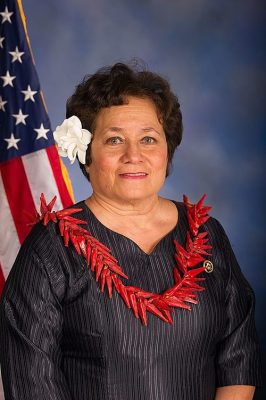 Delegate Amata Radewagen.
“I appreciate the work of the Peace Corps, including in our Pacific region, as a former staffer and my daughter is a returned Peace Corps volunteer, so I welcome their effort to double the current number of volunteers by 2030 to reach pre-pandemic numbers,” said Radewagen. “That said, the current funding level of $410 million, similar to the funding of a decade ago, does not account for the higher cost of living. We should ensure the agency can meet its recruitment goals while safeguarding the health and safety of its volunteers.”
The funding request letter serves as a confirmation of bipartisan support for the Peace Corps, as well as a guide for funding that meets the agency’s needs and demands of an evolving global economy.
Since the Peace Corps was founded in 1961, close to 250,000 volunteers from across the U.S. have served in more than 140 countries. Currently, more than 3,000 volunteers are based in more than 60 countries worldwide. Programs include agriculture, community economic development, education, environment, health, and youth in development.
The funding request initiated by Representatives Garamendi and Radewagen — and advocated for by National Peace Corps Association and broader Returned Peace Corps Volunteer community — is intended to inform the forthcoming “National Security, Department of State, and Related Programs Appropriations Act” later this year.
“The current funding for the Peace Corps amounts to less than 0.01 percent of the total U.S. federal spending and less than 1 percent of the international affairs budget,” said National Peace Corps Association President and CEO Carla Brown. “The return on investment for the U.S. is exponential. In fact, more than 85 percent of returned volunteers continue to volunteer in their communities across the U.S. — more than double the national average of nearly 30 percent.
“In any given year, Volunteers return home to lead large and small businesses, work in nonprofits, education, healthcare, diplomacy, or support their local communities in countless ways. The yearly economic impact of volunteers is between $752 million and $1.1 billion. While we understand the challenges of funding all U.S. programs domestically and internationally, the Peace Corps is well worth the investment.”