Tuesday, June 28, 2011 • Fire department changes its medical emergency response
Publisher’s note: This story originally appeared in the Tuesday, June 29, 2011 edition of the Lassen County Times.
As of July 1, the Susanville Fire Department is changing the way it responds to medical emergencies.
 Firefighters and ambulance EMTs work together to secure and transport truck driver Robert Young from a truck accident on June 1. As of July 1, firefighters will only respond to medical emergencies based on need, requests from ambulance services and dispatch center discretion.
Since 2004, the SFD has responded to each ambulance request for service in the city. But according to Fire Chief Ted Friedline the department will revert back to responding to medical emergencies based almost exclusively on need as of July 1.
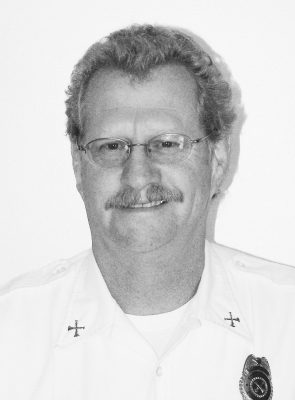 Ted Friedline.
“When we’ve done our annual reports, we’ve been questioned as to why we do so many medical calls,” Friedline said at the Susanville City Council’s June 15 meeting. “Prior to SESMA coming town, we’ve been running around 754 medical calls. Since then we’ve increased by an additional 513 calls per year.”
Friedline explained while the department has the ability to provide basic life support, the ambulance provides advanced life support. He said many of the calls they respond to are actual emergencies, whereas some of the calls had firefighters responding to incidents where patients were exhibiting flu like symptoms.
“I feel that can endanger our staff, they can get sick,” Friedline said. “So, what I’m planning on doing on July 1 is cutting back on the medical calls we’re going to, and changing our dispatch policy.”
Friedline said the department will now respond to medical emergencies based on four factors: a direct request from the ambulance service, discretion from the fire dispatch, general need or if an ambulance is not readily available. Friedline said this is the same response procedure as the Susan River Fire Protection District and Country Riverview Villa Nursing Home as of Jan. 31. Friedline said his department was currently providing first response service to the nursing home and SRFPD as well.
“So far, we haven’t had any complaints,” Friedline said. “I’m not aware of anyone losing their life because we didn’t respond to a call.”
Friedline said he thought the change was in the best interest of the fire department, especially as a cost-saving measure. For starters, the new policy would save the department on fuel, which Friedline estimated the department burned through at least one gallon of fuel every time an engine is pulled out of the station and has to idle for 20 minutes, a common occurrence on medical calls.
Friedline said it would also save money on tires and natural gas costs.
Even though the department will be responding to fewer medical calls, Friedline said the department would be reviewing this policy every three months for the next year and adjust accordingly.
“I’ve discussed it with my staff and it seems some of the community has heard about (the policy change),” Friedline said. “We realize its not going to be popular with everybody in the community.”
 Joe Franco.
Councilmember Joe Franco asked Friedline if there was any compensation that could be recouped if the fire department was the only responding unit after meeting the new criteria for medical response.
Friedline explained the department has never billed in the past for its EMS services, and because the department never transports patients, it wouldn’t work. He said SEMSA replaces any medical equipment the department may use in a medical response, but that’s it as far as compensation.
Friedline stressed this doesn’t mean the department will cease medical responses. He said in some cases, the department would have to wait awhile for an ambulance located in Westwood or Janesville.
The new policy will take effect on the same day the department plans to let go of full-time temporary firefighter Matt Claiborne. Claiborne is being let go in conjunction with various cuts being made throughout the city structure in order to operate with a balanced budget.