Tuesday, Nov. 6, 2018 • City responds to fired police officers’ petitions
Publisher’s note: This story originally appeared in the Tuesday, Nov. 6, 2018 edition of the Lassen County Times.
The city of Susanville, represented by a Sacramento law firm, filed a “verified answer” to petitions for writs of mandate filed in August by two fired Susanville police officers — Sgt. Michael Bollinger and Lt. Mathew Wood.
 Sgt. Mike Bollinger.
The filings by the officers and the city’s response to each generally cover the same legal ground.
 Lt. Mathew Wood.
No new court dates have been scheduled and both Lassen County Superior Court Judges — Tony Mallery and Mark Nareau — have recused themselves from the case.
The officers ask the court for a judgment “setting aside and vacating” the city’s decision to terminate them and that the court issue a writ of mandate remanding the case back to the county for “further proceedings consistent with this decision;” for reasonable attorney fees; for the costs of the suit; and other and further relief as the court deems just and proper.
A writ of mandate is a judicial remedy in the form of an order from a superior court, to any government subordinate court, corporation or public authority — to do (or forbear from doing) some specific act which that body is obliged under law to do (or refrain from doing) — and which is in the nature of public duty, and in certain cases one of a statutory duty.
The city asks the court that the officers take nothing by this action; that the court deny the request for the writ; and the court award the city reasonable cost in the case; and that the court award the city further relief as it deems just and proper.
City’s findings and conclusions of law
The city issued a report on the “findings of fact and conclusions of law” after completing the appeals from the two officers, and both were terminated.
 John King.
According to the court documents, when Wood discovered a background document used in the hiring of John King, former police chief, contained his signature, but he did not sign it, he brought it to Bollinger’s attention. They agreed the background investigation should stop and that a crime report should be filed. Bollinger contacted the Lassen County Sheriff’s Office, and it declined to file the crime report.
According to the city’s report, “It was ultimately determined that the outside investigative firm doing the background investigation had used a blank background inquiry form which had been signed by the lieutenant in the context of an unrelated background investigation a few years earlier.”
According to the council, that action by the outside investigative firm “did not satisfy the elements of criminal fraud.”
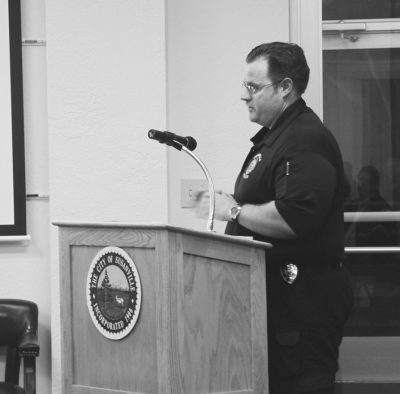
 Jim Uptegrove, Susanville’s interim police chief, explains the new Crime Stoppers program to the Susanville Rotary Club.
Wood brought the matter to the attention of Jim Uptegrove, the interim chief of police, who told Wood to “do nothing further” and he “would handle the matter.”
Despite this order, the officers completed a crime report that “included confidential information about the successful candidate for chief of police and forwarded that report to both the district attorney and the state department of justice. Neither agency pursued any criminal charges or any further criminal investigation of the matter.
Wood made copies of these confidential documents with led to a personnel investigation to determine if the officers’ actions “constituted violations of department or city regulations.”
By a vote of 4-1, the council made three findings and terminated Wood.
The city found Wood failed to follow Uptegrove’s directions, which it considered “a valid order.”
Wood also violated record handling procedures and sate law by copying and distributing the personnel documents.
Wood also violated the department’s security policies by making unauthorized copies of the documents.
City’s response
In its response filed with the court, the city of Susanville offered 10 affirmative defenses to the officers’ allegations. An affirmative defense is a fact or set of facts other than those alleged by the plaintiff or prosecutor which, if proven by the defendant, defeats or mitigates the legal consequences of the defendant’s otherwise unlawful conduct.
The city’s first affirmative defense — no violation of rights — is that the city acted in good faith and did not perform any acts that would violate any right or duty owed to the officers.
The city’s second affirmative defense — failure to mitigate damages — argues the officers failed to mitigate and limit their damage claims and therefore they are estopped from asserting such a claim and seeking relief from the city.
Estoppel is the principle that precludes a person from asserting something contrary to what is implied by a previous action or statement of that person or by a previous pertinent judicial determination.
The city’s third affirmative defense — waiver — is that the officers engaged in conduct that waives any alleged duty by the city and precludes any recovery by the officers.
The city’s fourth affirmative defense — estoppel — is that the officers are barred by the equitable doctrine of estoppel.
The city’s fifth affirmative defense — unclean hands — is that the officers are barred due to the doctrine of unclean hands.
The city’s sixth affirmative defense — acts or omissions by the plaintiff — alleges any damages suffered by the officers were caused by their own actions or omissions.
The city’s seventh affirmative defense — statute of limitations — argues the complaint is barred by the statute of limitations.
The city’s eighth affirmative defense — acts or omissions of plantiffs — alleges “each and every cause of action or count contained therein fails to state facts sufficient to constitute a cause or action against or claim against the city.”
The city’s ninth affirmative defense — immunity — is that the city, as a public entity, is” immune from any and all liability” due to provisions of the government code.
The city’s tenth affirmative defense — exercise of discretion — is that any acts or omissions by the city and its officials, as a public agency, were discretionary and the city is not liable to the petitioner under the Government Code.
City responds to officers’ specific allegations
The city admits Bollinger’s first eight allegations in its verified answer — that the city council is a public entity within the state and in part responsible for ruling upon cases of employee discipline (1), that Bollinger was employed as a police sergeant (2), that he was a permanent employee of the city (3), that the petitioner, respondents and as many as 10 unidentified parties will be affected by this petition (4), that Bollinger received a termination notice on or about July 6, 2017 (5), that Bollinger timely appealed and the matter was set for a hearing (6), That a hearing was held March 19 and March 20 and May 11 before the council (7), and “evidence both written and oral was introduced on behalf of the petitioner and the respondents and the record was submitted for decision,” (8).
In his ninth allegation, Bollinger wrote, “the administrative record has been requested by the petitioner and will be lodged with the court prior to the hearing on this matter.
The city responded, that this allegation “makes no factual allegation and thus is subject to neither admission nor denial. That being said, the administrative record is being prepared.”
In allegation 10, Bollinger alleges he has complied with “all provisions of law” and has “exhausted all administrative remedies.”
The city responds the city “lacks sufficient information upon which to base either an admission or a denial, and on that basis denies the allegations contained in this paragraph.”
In allegation 11, Bollinger alleges he has no “plain, speedy or adequate remedy at law.”
The city again responds it “lacks sufficient information upon which to base either an admission or a denial, and on that basis denies the allegations contained in this paragraph.”
In allegation 12, Bollinger alleges the council “abused their discretion by imposing and sustaining such a severe and unconscionable punishment based upon petitioner’s conduct.”
The city denies that allegation.
In allegation 13, Bollinger alleges, the council abused its discretion because its decision “is not supported by the findings.”
The city denies that allegation.
In allegation 14, Bollinger alleges, the council abused its discretion because its findings are “not supported by the weight of the evidence.”
The city denies that allegation.
In allegation 15, Bollinger alleges, the council abused its discretion because “they have not proceeded in a manner as required by law.”
The city denies that allegation.
In allegation 16, Bollinger alleges the council and each councilmember “acted arbitrarily, capriciously and unreasonably in excess of their jurisdiction and their conduct is not supported by fair and substantial reasons,” making Bollinger entitled to an award of attorney’s fees.
The city denies the allegation.