Tuesday, Oct, 15, 2013 • Conquering Split Mountain leads to High Sierra adventure
Publisher’s note: These stories originally appeared in the Tuesday, Oct. 15, 2013 edition of the Lassen County Times.
In California there are 15 peaks higher than 14,000 feet in elevation. Thirteen of these occur in the Eastern Sierra, the others being White Mountain Peak in the White Mountains on the east side of the Owens Valley, and Mt. Shasta in the Cascades to the north of here.
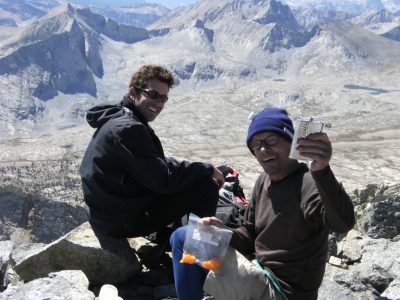 Mountaineers John Zueck, left, and Susanville resident Fritz Rollins, celebrate their September conquest of Split Mountain, a 14,058 foot peak in the Eastern Sierra.
About 15 miles of the Eastern Sierra crest includes the mighty Palisade range where seven of these peaks tower 10,000 feet above the Owens Valley floor. With their steep ramparts, cathedral like spires, massive buttresses, gullies (couloirs), steep twisted ridges (arêtes), deep canyons and stark walls, these are among the most awesome and sought after major climbs in the Sierra. The vistas from these summits are the finest in all of California. The late Norman Clyde, probably the most prolific climber the Sierra has ever seen, once remarked that the Palisades are what mountains are supposed to be — incredibly rugged.
Split Mountain, at 14,058 feet, is one of these mountains, the southern most of the Palisade range first climbed in 1895 by John Bolton. A mountain further to the north in this range is named in his honor. This massive mountain has two summits, the northern one being the true summit. These summits are separated by deep gullies ascending more than 3,000 feet from its base.
Our group of intrepid climbers met early in the afternoon of Sept. 4 in the little town of Big Pine about 15 miles south of Bishop. There were six of us — Gabe Saia, from Phoenix, Arizona, Tom Cook, who was our photographer, Paul Bettencourt and Dan Aspromonte (our gourmet cook), from the San Francisco Bay Area, our fearless leader, John Zueck, from Santa Cruz, and myself.
Looking toward the west we had a good view of the distant southern slopes of Split Mountain, the rest of the mountain being hidden by the high ridges that we needed to climb on the way to Red Lake. From where we stood, it appeared as if the desert went as far as the mountain itself. This was going to be a long, hot climb. Fortunately, we were not affected by any of the smoke from all the fires.
As planned, we got an early start at 7 a.m. and at 2:30 p.m., we finally arrived at Little Red Lake where we got our first close-up view of Split Mountain. The numerous cliffs that make up the eastern ramparts of this massive mountain were colored with bands of red, orange, brown and other tints which made the view all the more awesome when silhouetted against an azure sky.
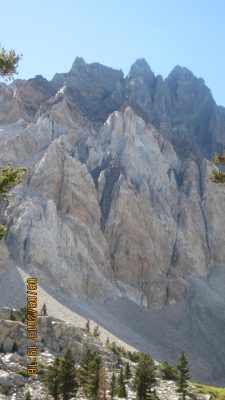 Split Mountain got its name because of the split between its two summits.
Red Lake is nestled in a bowl surrounded by the ridges of Mt. Tinamaha to the north and the slopes of Split Mountain on the west and south. At 10,500 feet, vegetation consists mostly of stunted White Bark pines, a few Jeffrey pines and some White fir along with some late summer wild flowers in meadows around the lake.
Red Lake has a slight greenish color to it due to the glacier silt from the runoff of the small glaciers at the bottom of one of the gullies. The remnants of these glaciers, as with all the other numerous glaciers now in the Sierra, started forming during the Little Ice Age sometime between 500 and 700 years ago and ending sometime in the 19th century. The massive glaciers that helped sculpt the Sierra disappeared about 10,000 years ago.
A night under the stars, especially at high altitudes, is a memorable experience. High up, away from city lights, there are many more stars that can only be seen clearly up here in the more rarified atmosphere. The light from all these stars and the Milky Way supply enough light to outline all the mountains and ridges in ghostly shapes. It is no wonder that many observatories are located in the high mountains.
We were up before dawn the next day to get an early start as we had a long, tough 3,500 feet climb ahead of us. One member of our group was suffering from altitude sickness and decided to stay in camp.
The standard route up the mountain is similar to the first ascent by Bolton back in 1895. His route started from the west side of the mountain and obtained a gradual summit ridge at well over 13,000 feet. Our eastern approach would meet this same summit ridge after a long climb up the northeastern slopes of the mountain. Essentially our route took us to the north around the backside of the mountain. Routes up the steep ridges and gullies have been established, but they are highly technical. These climbs are among the longest and most difficult in the Sierra.
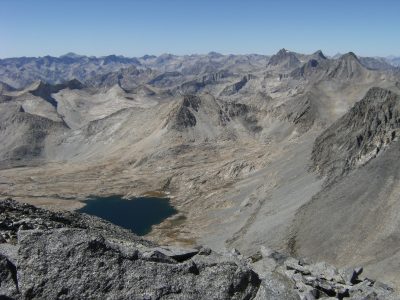 The treeless expanse of the High Sierra and the Palisades (right) stretch as far as the eye can see in this view from the summit of Split Mountain.
We made good progress up the long, gradual, boulder-strewn slope. We arrived at the bottom of a long chute at about 11 a.m. Looking up the 65-degree narrow route, we could see the notch at the top about 300 feet above, which was our immediate objective. Though quite steep, there were plenty of secure handholds and footholds all the way up. This is the final push up to the summit ridge heading west.
Arriving at the summit a little after noon, we signed the register, had some lunch and took in the awesome view from the top. From our vantage point, the views down the steep cliffs and gullies dropping down to Red Lake more than 3,500 feet below were incredible. We were able to view the rest of the Palisade range as it snaked up to the north. A few miles away we could see the Middle Palisade that had defeated us last year as well as a few we had successfully climbed.
Looking east, 12,500-foot Mt Tinamaha blocked our view of the Owens Valley far below. The northern part of Upper Basin in Kings Canyon National Park was visible to the west. Far below we could see the shimmering lakes of the basin joined together like beads on a string.
The black jagged South Summit as well as countless mountain ranges as far as the eye could see rounded out the 360-degree panorama. Several miles to the south, Mt. Whitney, the highest peak in the lower United States, was barely visible.
It was time for a toast to our success. Dan had carried a flask of Grappa all the way up just for this occasion. Grappa is a strong (100 proof) uniquely Italian drink originally from a little town in Italy by the same name. This potent drink is made from seeds, stalks and skins left over from the wine making process. I was told Grappa is good for the digestion; at least that sounded like a good excuse (if one were really necessary).
After we drained the flask, it was time to go. Picking our way down the steep chute was going to be slow going. It was dark by the time we finally reached our camp.
This had been an incredible adventure. Not only had we successfully climbed another 14,000-foot mountain, but the camaraderie of the group and just being in the mountains surrounded by incredible scenery made the hard effort all the more worthwhile.
Why do people climb mountains?
People often ask — what pleasure does a person derive from such a strenuous experience?
To say as George Leigh Mallory did back in the 1920’s about climbing Mt. Everest, “because it’s there,” is just a cliché. Truly, climbing is part of the wilderness experience, as well as a challenge to conquer something difficult and demanding of a person’s endurance and perseverance.
Seven years ago I joined a climbing team dedicated to eventually climb all of the 14,000-foot peaks in California. This group consists of a bunch of rambunctious fellows mostly belonging to a close-knit Italian family from as far away as Southern California and Arizona. Once a year we all try to get together to attempt one of these mountains. By the time I joined up, all the easier ones had been picked off. Easy routes on the rest of these mountains were getting harder to find. Not being technical climbers, our group never attempts any mountains that require technical climbing skills.
From the top, the awesome views make the effort worthwhile, as one feels overwhelmed by the experience. For a little while, the cares of the world seem remote as you gaze into infinity.
Beyond that, the beauty of the high Sierra has no equal. Excellent weather during the summer, enchanting alpine basins, the lofty peaks, riots of wildflowers along streams and verdant meadows, the brilliant starlight, as well as the solitude, all make for a memorable adventure in the wilderness.
Who can forget the grandeur of the stark jagged walls of these mountains, the azure blue of the alpine lakes, the roar of a waterfall? This is what beckons us to return year after year.
Climbing routes are listed in guidebooks by a standard class rating system. Class one is easy trail walking. Class two is rough cross-country hiking and climbing over rock and difficult terrain. Poorly maintained trials sometimes fall into this category. Class 3 climbs require use of handholds when scrambling over and around rocks on a fairly steep slope.
A rope is carried for inexperienced climbers as a fall can result in serious injury. Class 4 is on much steeper terrain where hand and foot holds are much smaller and a rope is always carried, as a fall can be fatal. This type of climbing is not recommended for persons with vertigo. There is so much exposure and difficulty in class 5 climbing that the lead climbers puts special anchors in rock crevices to limit the length of a fall. This class is further divided into a decimal system to describe additional degrees of difficulty.
As of this writing we all have recovered and planning next year’s adventure. Our sights are on Mt. Russell, just north of Mt. Whitney. We have tentatively written off three of the peaks. These peaks are only considered “summits” by some, and not actual separate mountains, but “bumps” along a short part of a high ridge that makes up part of the Palisade range.
Anyway, climbing these require more advanced climbing skills, which is why they are not on our bucket list.