Tuesday, Sept. 7, 2010 • City discusses drafting water use policy for outside fire agencies
Publisher’s note: This story originally appeared in the Tuesday, Sept. 10, 2010, edition of the Lassen County Times.
A combination of several factors at a recent fire on the edge of the city limits led the Susanville City Council to begin discussing the implementation of a policy that would partially regulate use of the city’s water supply by other local fire agencies.
The city’s Public Works Department was scrambling to fix a water supply problem on July 22 when a rock broke a piece of pipeline below the brake check area on Highway 36, which caused a lot of water to start pouring out of the Cady Springs water line.
At roughly the same time, multiple fire agencies responded to a fire along the edge of Highway 36 near the Susanville Auto Center.
 Peter Talia.
As City Counsel and Interim City Administrator Peter Talia said, “There was an emergency need for water to mop up the fire. As it developed, there was a severe water emergency occurring simultaneously due to a break in the line from Cady Springs. As a result, water levels were already dangerously low when water was being drawn from a city hydrant by a water tender from the Susan River Fire Protection District.”
Talia explained how he has worked with a both Public Works Director Craig Platt and Susanville Fire Department Chief Ted Friedline in developing a policy for critical situations where the water supply is already dangerously low.
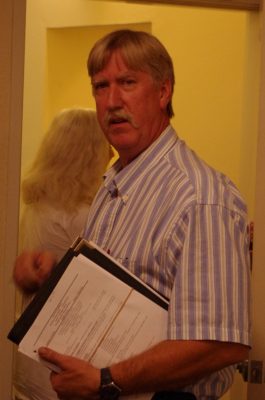 Craig Platt.
“It’s one of those catch 22s I guess,” Platt said. “One is fire (suppression), which we all support, and the other is ratepayers who we have to protect. There are laws that cover what we can and can’t do with ratepayers. This came up because we had two incidents going at the same time.”
SRFPD Chief Glenn Hodgson said he was there for the fire incident along the highway. He said the issue arose when his department was told not to draw water for the mop effort of the fire, which was deemed as a non-emergency use at the time. He said his department drew the water regardless, because mop up procedures are critical for making sure a fire doesn’t restart and begin firefighting efforts again.
Hodgson said when it comes to proper fire suppression technique, his volunteers, like the SFD, are going to attempt to draw from the most accessible water resource in the area, whether it costs something or not. He said if the SRFPD had to start paying for the water it needs to do its job, then it may not be able to respond to as many incidents, with its current barebones budget.
Janesville Fire Chief Dan Paulsen said from what he saw on the water charge, it would come out to roughly $1 for every 1,000 gallons other local fire agencies would be charged to draw upon the city’s water supply. He said the city has the only viable water supply in the county for insurance purposes, and he was concerned about the effect a water use policy would have on everyone’s ratings.
“Janesville is currently trying to get a better fire rating, and Glenn’s in the same boat,” Paulsen said. “We have entered mutual and automatic aid, along with Milford and Standish. We go after whatever water supply we can, and sometimes we have to tap into the city in order to do that. I don’t think that’s going to change any time soon.”
Former Office of Emergency Services Chief Chip Jackson explained how this policy concerned him because he was worried about the affects this policy would have on the last 40 plus years of positive mutual aid between the agencies.
“For a lot of years, we’ve been working together in the spirit of cooperation,” Jackson said. “We have hundreds of thousands of dollars worth of equipment going in both directions from the city and from the county and the districts in their time of need. As a (Susanville city) councilmember, I was there when the water system was put into place. I understand there’s a lot of infrastructure to pay for. I just want to make sure we don’t do something that will take that spirit away.”
Jackson added in the event of the city’s water system failing, which he said can happen and has happened in the past, water tenders all the way to Doyle have come in to protect the city and the city has reimbursed those agencies accordingly.
 City councilmember Lino Callegari.
Councilmembers Lino Callegari and Joe Franco said they wanted city staff to look into having extra water storage tanks available along the edges of the city limits to help assuage the need to tap into the city’s water supply as much.
 Joe Franco.
Talia also told all fire personnel at the meeting that if there were any other concerns with the wording or creation of the water policy as it was being put together, they should stay in touch so their ideas could be incorporated.