Fair’s budget woes — No one saw this coming?
While Richard Egan, Lassen County administrative officer, portrayed the red ink in the Lassen County Fair’s year-end numbers as “the elephant in the room” that raised all kinds of red flags at a recent Lassen County Board of Supervisor’s meeting, the historic record of the fair’s finances during Egan’s tenure suggests county leaders took their eye off the fair the last three years and therefore failed to see the issue growing right in front of them.
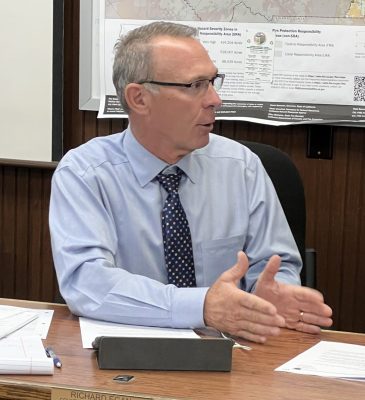 Lassen County Administrative Officer Richard Egan.
Lassen News asked Lassen County Treasurer/Tax Collector/Auditor Nancy Cardenas to help us sort through and understand the financial data behind the recent Lassen County Fair budget uproar. Here’s some eye-opening, eyebrow-raising information she provided during our exclusive interview last Friday afternoon.
 Nancy Cardenas.
2021
According to Cardenas’ accounting, there was no fair in 2021 due to the COVID-19 pandemic. The fair’s June 30, 2021 closing balance was only $10,478.44. The county’s general fund contributed $100,000 to the fair’s budget that year.
2022
In 2022, the fair received $900,000 in Dixie Fire money from the state for housing firefighters and evacuees. The county made no general fund contribution to the fair in 2022. That year, the fair spent $355,551.13 from its fair balance. The June 30, fund balance was $544,488.87.
2023
Despite expending almost $356,000 from its account in 2022, in 2023 the board of supervisors increased the fair’s budget to $1.18 million (up from $1.06 million in 2022 and $607,778.00 in 2021). In 2023, the fair spent $392,222.46 from its fair balance. The June 30, balance was $152,226.41.
2024
Despite spending nearly $393,000 from its account in 2023, the board of supervisors increased the fair’s budget to $1.243 million in 2024. That year, the fair spent $152,226.41 from its fund balance and was over budget by $294,721.09 for a total loss that year of $446,947.50. The county made no general fund contribution to the fair that year. Cardenas said the fair’s payroll expense in 2024 was $404,046.24.
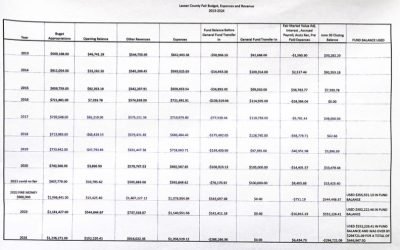
“I did not create these numbers,” Cardenas said. “These numbers came from actual county reports that are available to the administration. As you can see, if you look at the true June 30th balances (the date the county closes its fiscal year), the fair is in the hole almost every year by the end of June — except when they got the fire money (in 2022), and the county comes in and bails them out. In Richard’s tenure, the general fund, not counting fire money, has contributed $924,805 to the fair.
“Then they gave her the entire $900,000 of fire money from 2021 fiscal year for a total that has been given to the fair in Richard’s tenure of $1.8 million.”
Cardenas gathered information going back to 2018 and noted several general fund categories — public safety, for example — go into the negative at different times of the year in larger amounts than the fair.
When this happens, Cardenas said, “No one asks me not to pay their bills, and no one asks me not to do payroll for them because they’re waiting for their revenue streams to come in. The county basically floats them, and when their revenue streams come in, the fund is made whole and they get the remainder of it.”
She said while the fiscal year ends June 30, the auditor’s work is not completed until mid-August because the office has to wait until “any and all revenue to come in from the state that is earmarked for June 30. Sometimes we don’t get that until August, and we have to wait for that to make these funds whole again. So, it is not uncommon for a fund to be waiting for revenue to come in the make it whole, and the county does not ask any other fund not to be paid.”
Cardenas simply said, “That’s not how it works.”
She pointed to the time the county’s general fund was $3 million in the hole.
“Do you think we didn’t make payroll in November 2018?” Cardenas asked. “We were waiting for money that didn’t come in until June 30. We were in the hole in and out that entire year. That’s the way government works. We know that this money is coming in. We know that we’re going to get this money. It’s a little different for the fair, but if she would have had a chance to plan her fair, and to do her different revenues — all of her stuff comes in during the spring … Fairs run on a calendar year, and the county runs on a fiscal year.”
Cardenas said that’s the problem — the fair is held in July, but it doesn’t receive any money until January because that’s when the state fair board starts its year.
And she said the same thing happens with the county’s budget waiting for federal funding to come through.
“That’s not uncommon either,” Cardenas said. “Every different entity that a government agency works with has different fiscal years, has different starts, and that’s when your funding comes in. That’s why you see anomalies like this happening. It’s just business as usual.”
Cardenas said even though there was no fair in 2021 due to COVID, the fair’s payroll expenses were still $262,440.85 for the year. With no fair!
“No one said anything to her (Kaitlyn Midgley, fair manager) about being over that amount,” Cardenas said. “Like, what’s wrong with your budget? We need to talk about this. It doesn’t matter that she has a fund balance because she’s blowing through her fund balance and somebody should have said, ‘Maybe we need to look and see why the fair is bleeding out this amount of money. But no. The next year, they increase her budget to $1.1 million. They carry that over. She makes $730,000. In that year (2023) she was actually short $392,000 … ”
At the end of 2023, she has a fund balance of $152,226.41 left.
“She has not made any money in either of these two years,” Cardenas said. “She has bled out more money than the fair has bled out any previous year being short. No one has said anything to her. No one has noticed that maybe we should watch her budget or maybe we should talk about expenses or any of that. She only has $152,000 and they’re supposed to take that into account when they’re doing the budgeting, and yet we let her increase her budget again.”
Cardenas noted the fair’s revenue trend was going up — the fair was bringing in more money than it had brought in under any other fair manager — however, her expenses were also ticking up.

Hidden Woods
Cardenas acknowledged the Hidden Woods Music Festival lost money this year. She said Midgely estimated that loss to be about $300,000, “but when you add in what she was going to be short on payroll, you’re looking at $800,000 (for the year) … and she knew this. The fair could not bring in enough revenue on its own to fund 100 percent all of the salaries and everything for the fair. She was always going to be short. I’m sure she knew that. I’m sure she had done this analysis. I’m sure these two years made her think, ‘Wow, I need another event.’”
But Cardenas said these numbers she’s talking about here should have been a major red flag for county leaders.
“She’s budgeting more, she’s blowing through her fund balance, we’re letting her have more of a budget, and nobody’s talking to her about that?” Cardenas asked. “The board should also have been told, because they are the fair board, right? They should have been informed by someone, either who she reports to administratively, the CAO (she’s his employee) should have said, ‘I have concerns because we gave you $900,000 in 2021 and we’re down to $152,000 (fund balance) and her budget’s increasing. We’re going to have a problem.’ And I don’t think that’s difficult math. I think when you’re looking at this trend it’s pretty apparent what’s going to happen. The higher her budget gets, the shorter she becomes. And payroll. The county gives a 10 percent payroll raise, worker’s comp went up. All of our budgets take that hit every year, and the county basically picks it up for all of us … They pay that, and (District 1 Supervisor Chris) Gallagher even said, ‘I don’t know why we expect Kaitlyn to take care of her payroll.”
Cardenas said the fair is the only county department that must generate the revenue to pay its employees — and the fair does hire extra employees during the fair increasing that cost.
“My question is, is it fair that the county doesn’t pay for her regular staff payroll for three employees, and Jim’s (Wolcott) retirement because that’s in here, too?” Cardenas asked. “This is part of the budget process that’s done by the CAO.”
Why does this matter? In 2024, Cardenas said the fair’s budget was short $446,947.50. Then she noted the fair’s payroll expense that year was $404,046.24.
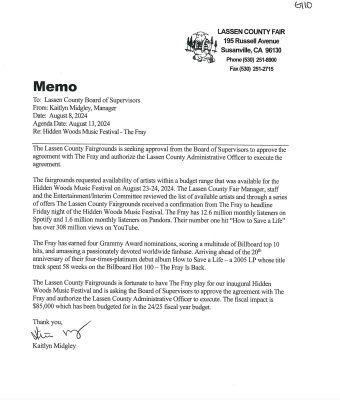
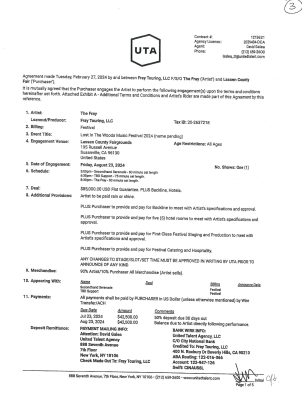
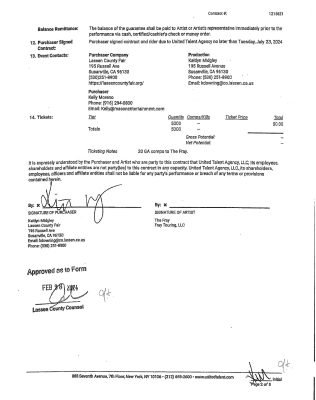 While the Hidden Woods Music Festival contracts became a bone of contention at an Aug. 8 Lassen County Board of Supervisors meeting, county counsel approved this contract with The Fray for form Feb. 8.
Fray contract
Cardenas acknowledged when entertainment contracts came in during her tenure in 2024 that were over Egan’s signing authority, she should have brought those contracts to the board of supervisors. But she added no entertainment contract has ever been brought to the board during Egan’s tenure no matter what the amount of the contract.
“If these contracts go to the board, they’re public information, and they lose that marketing tool,” Cardenas said. “I think that’s why entertainment contracts didn’t go to the board … He didn’t care about the country singers (contracts) not going to the board, it was only Hidden Woods that he’s hitting me on, and he should have to be responsible for all those other years they didn’t (go to the board) during his tenure.”